Image generated by Gemini.
“How did it feel to kill 5 million people?” This was a question about the decision to launch nuclear weapons that I didn’t think I would ever be asking until a couple of weeks ago; I ended up posing this question more than once.
The responses ranged anywhere from “My team was probably going to lose anyway, better both teams lose,” to “I see what war can do on my phone, a [tactical low-yield] nuke was bound to happen.”
Fortunately, the crisis was a fictional nuclear escalation scenario that I designed and ran at the Culver Academies, a leadership development academy based in Culver, Indiana. The purpose of the exercise was to educate students on how to make tough choices under conditions of asymmetric information, uncertainty, time pressure, personal incentives, and emerging technologies.
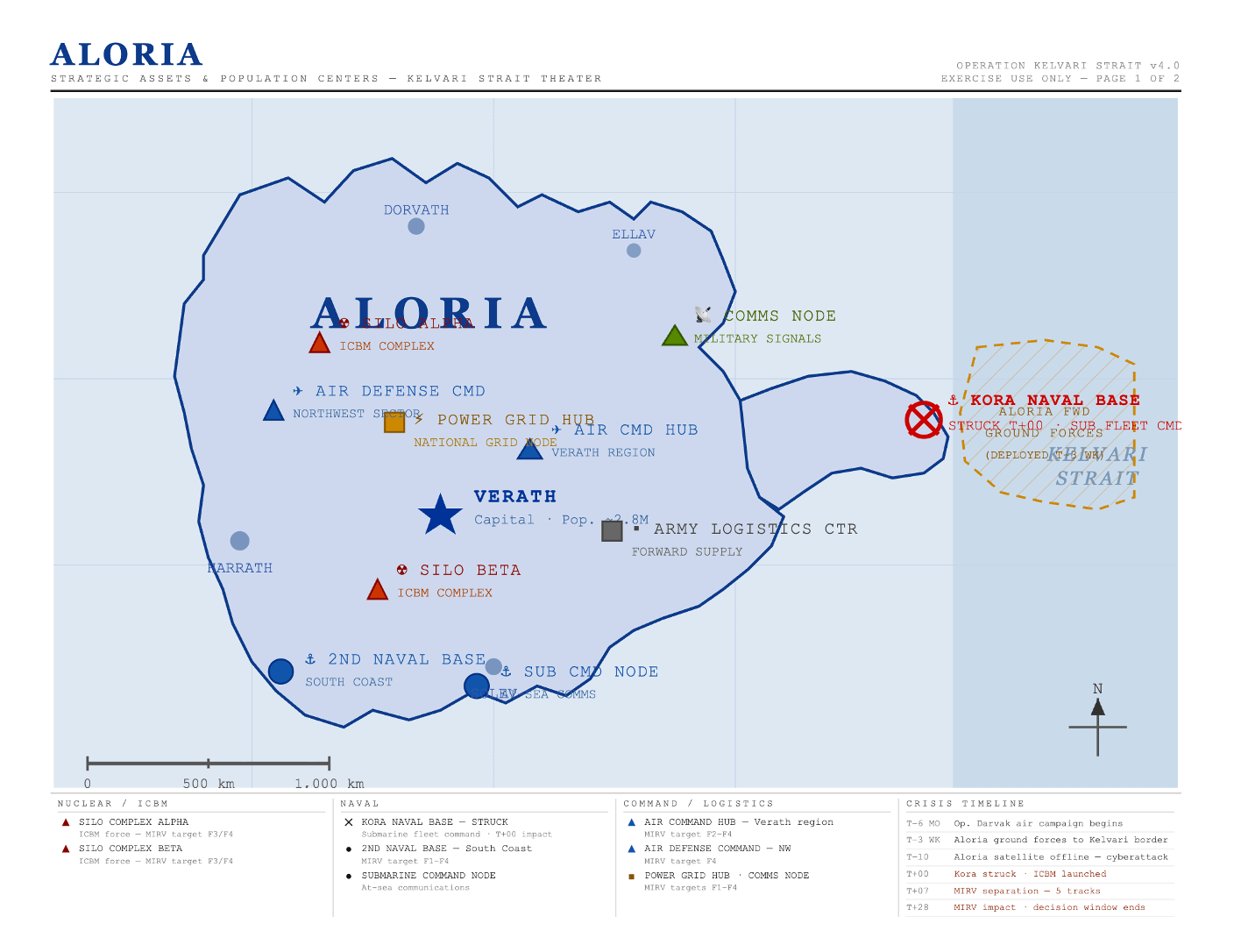
To the west: Aloria, a powerful democratic nation with a sophisticated military, land-based ICBMs, and submarine-launched ballistic missiles.
The simulation involved two countries separated by a stretch of water called the Kelvari Strait. To the west: Aloria, a powerful democratic nation with a sophisticated military, land-based ICBMs, and submarine-launched ballistic missiles. To the east: Tarshan, less powerful in aggregate but still technologically advanced, possessing land-based ICBMs and a reported breakthrough AI weapons program called Project ARGUS—theoretically capable of autonomously eliminating Aloria’s nuclear capabilities in a single “splendid first strike.”
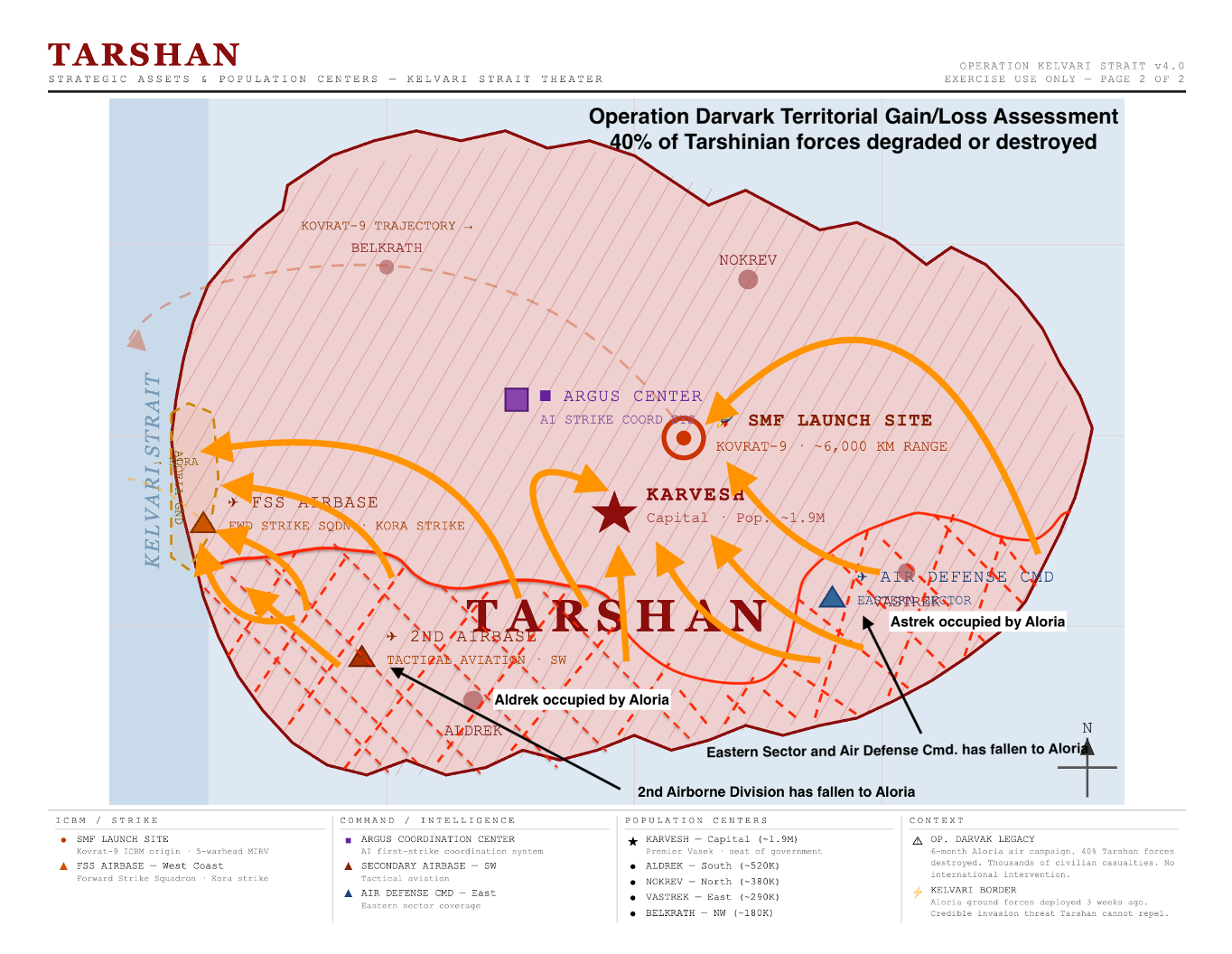
To the east: Tarshan, less powerful in aggregate but still technologically advanced
Six months before the simulation began, Aloria had launched Operation Darvak, a so-called counter-terrorism operation against Tarshan, which destroyed 40% of Tarshan’s military and killed thousands of civilians. Last week, Aloria moved ground troops to the border.
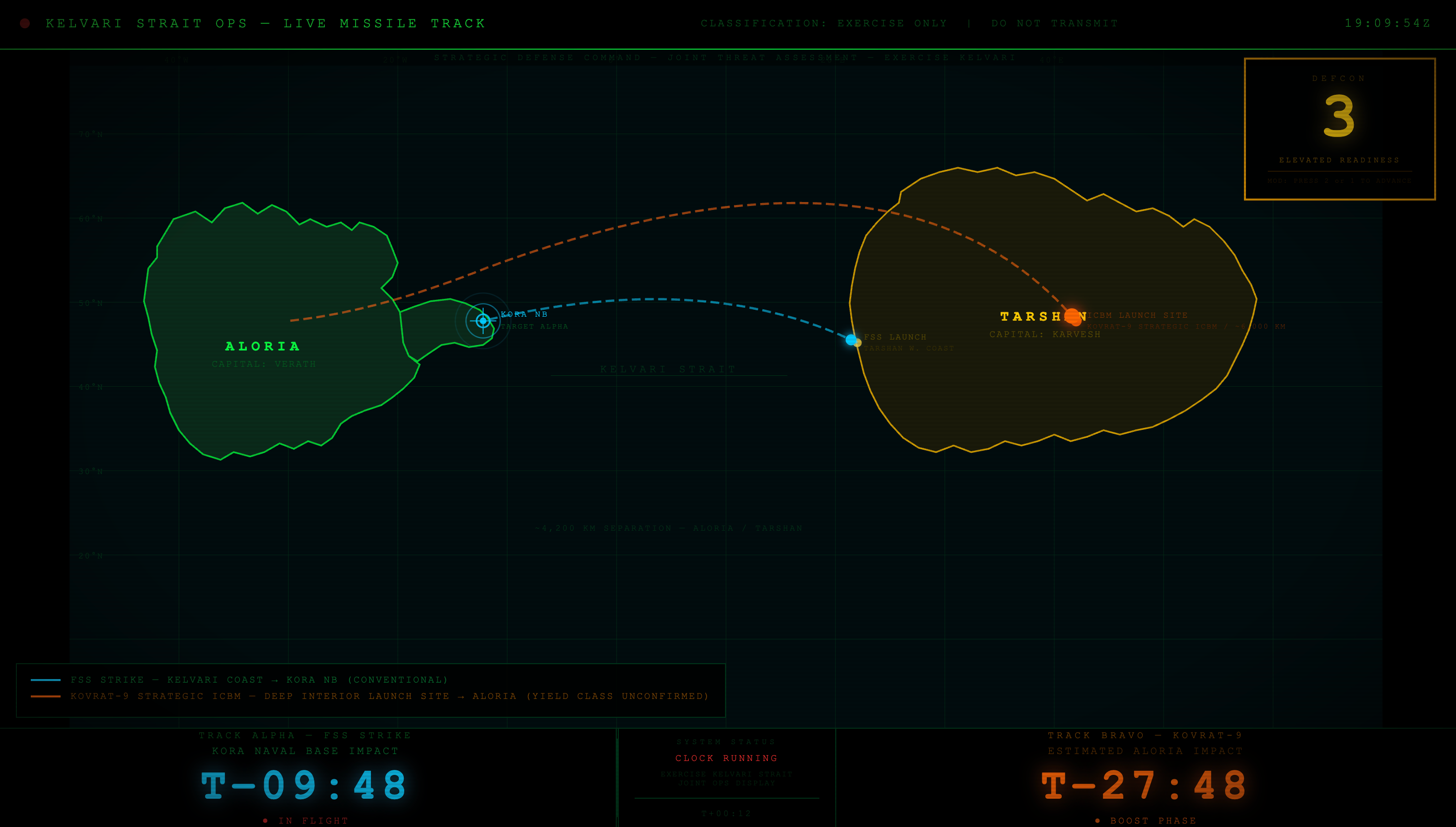
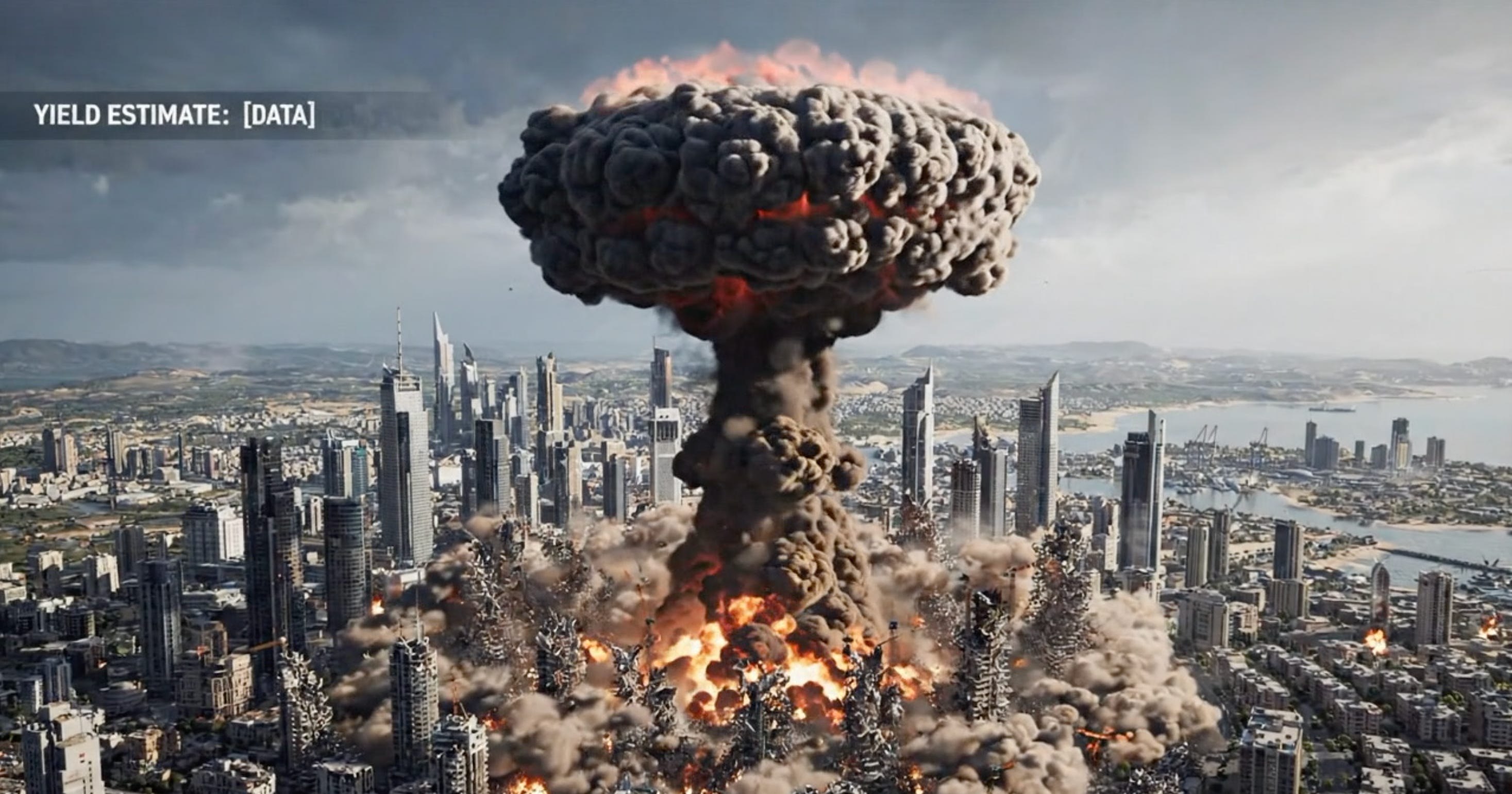
A screenshot of what was displayed on the big screen in each command center.
Then, ten minutes ago, Tarshan launched a conventional missile attack on Kora Naval Station, Aloria’s largest regional naval base. And then—a second launch. From deep inside Tarshan. An ICBM equipped with Multiple Independently Targetable Reentry Vehicles (MIRVs). Each one is potentially nuclear. Nobody in Aloria knows for certain what’s on it, but they have access to SENTINEL, an AI-enabled early warning system that can supposedly provide a confidence reading of the ICBM’s nuclear likelihood.
The script I read to open the simulation ended like this:
Aloria—your job is to figure out what’s coming at you, whether to trust your own AI system, and whether to respond before it hits. Tarshan—your warheads are already in the air. Aloria hasn’t responded yet. You need to decide if you’re going to try to stop this before it goes further. You have just 28 minutes. Then the warheads land. The decisions you make—or don’t make—will determine what happens to millions of Tarshinian and Alorian men, women, and children. Good luck. Protect your people. Your time starts now.
I ran this exercise three times with three different classes. The results were not what I anticipated. Originally, I had created this game to teach students in my generation about national security decision-making, but after every single class used nuclear weapons, I ended up being the student in an age-old class about human behavior.
To nuke or not to nuke?
Before the clock even started, the Tarshan teams had to decide what initial attack they wanted to launch.
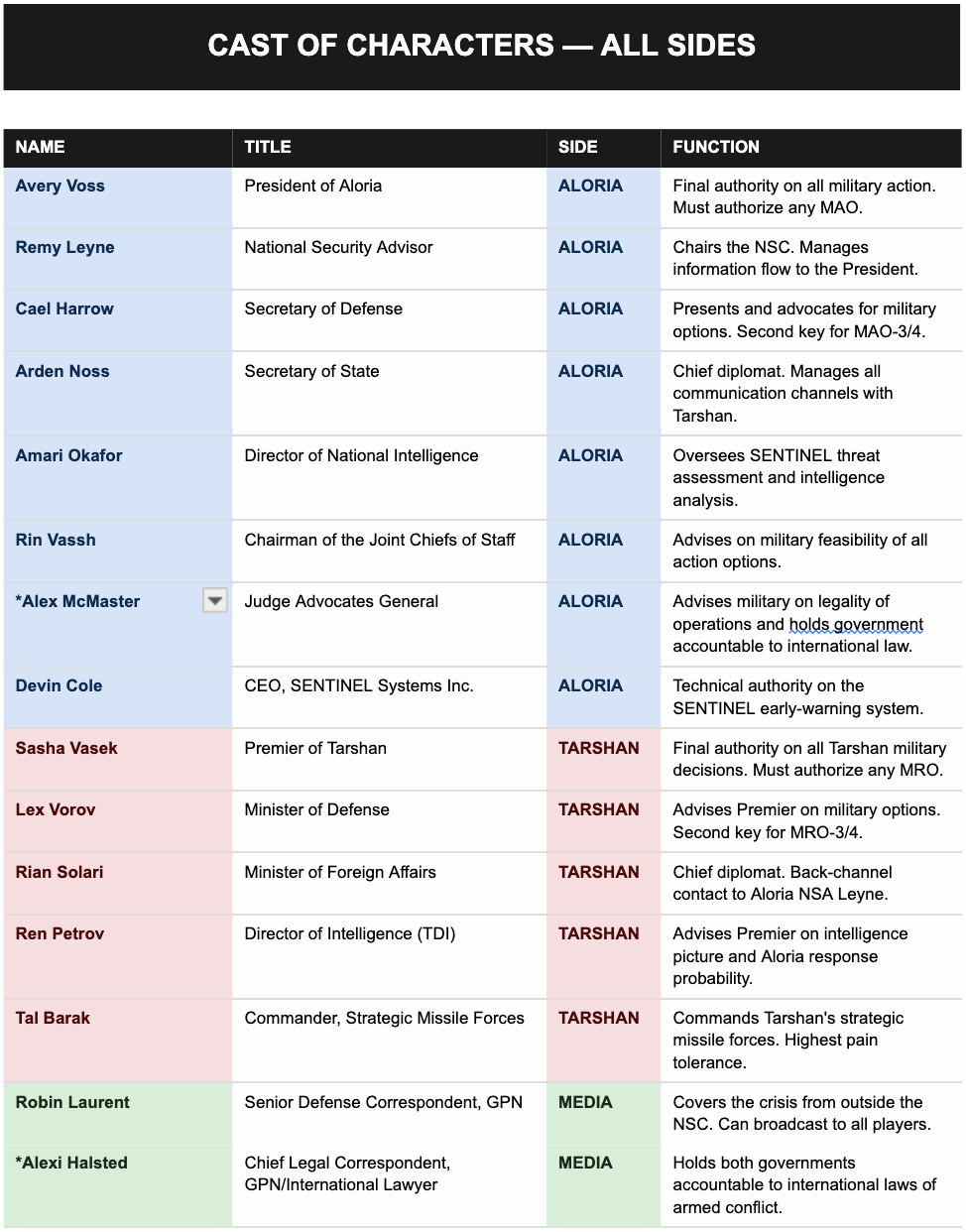
In a quiet room sat Sasha Vasek, the Premier of Tarshan. They were aided by their top advisors, Defense Minister Lex Vorov, Foreign Affairs Minister Rian Solari, Intelligence Director Ren Petrov, and Commander of the Strategic Missile Forces Tal Barak. Their job was to decide what to put on those warheads.
Option 1 was a conventional attack—five conventional precision missiles targeting counterforce targets in Aloria, which would cause severe infrastructure damage to Aloria’s military infrastructure.
Option 2 was a nuclear signal—a use of a low-yield, tactical nuclear weapon alongside four conventional missiles targeting counterforce targets in Aloria’s interior.
Option 3 was a limited nuclear strike—more severe than Option 2 but less severe than Option 4. Option 3 involved the use of two conventional missiles and two low-yield nukes targeting counterforce targets, as well as one high-yield strategic nuke striking just outside the Alorian capital of Verath.
Option 4 was an attempted disarming first strike—three high-yield and two low-yield nuclear weapons aimed at Aloria’s nuclear infrastructure (but close to Aloria’s population centers) that would hope to render Aloria’s second-strike capabilities severely degraded.
What was remarkable was how differently three groups of students, given identical information and identical roles1, reasoned their way to three completely different decisions.
In the first class, Tarshan’s Foreign Minister argued for a conventional strike and nothing higher than a nuclear signal. Tarshan’s Defense Minister and Strategic Missile Force Commander pushed for a disarming first strike, arguing that conventional warheads onboard an MIRV would look like a nuclear strike anyway. In the end, Premier Vasek took a deep breath and authorized Option 2: a nuclear signal.
The second class’s Tarshan team took a bit more of a pragmatic approach to the credit of Premier Vasek alone. Despite receiving near-unanimous advice to at least authorize Option 2, Premier Vasek firmly held that she did not want to be the one to break the nuclear taboo (although, of course, she didn’t know that the “nuclear taboo” was the term she was referring to), and opted for Option 1: conventional strike.
Despite only being “moderately hawkish” towards Aloria, Premier Vasek in the third class reasoned her way into a much more aggressive outlook on the situation. Using her personalist leadership style and the approval of her Defense Minister, who championed a hawkish position on Aloria from the start, she reasoned that, given that 40% of her military capacity had been destroyed in Operation Darvak, her regime would come to an end if Aloria’s military capabilities were left intact. Therefore, anything less than a full nuclear attack was not being half-safe; it was half-doomed to the toppling of her government. Premier Vasek authorized Option 4: disarming nuclear strike.
Table 1. What each Tarhsan group chose to put on the MIRVs.

28 minutes ‘til impact…
Understandably, Aloria was disorganized in the first few minutes. Rather than utilizing the provided back-channel communication mechanism (sticky notes passed between rooms) with Tarshan, the Alorian teams all tried to reason what was on the MIRV using a combination of their knowledge of the other side’s personalities, as well as the SENTINEL reading, which was reporting a 62.3% confidence that the warheads were nuclear. That number wasn’t high enough to be certain, but it was far too high to ignore. What’s interesting is that Aloria used the back channel only after Tarshan initiated the conversation. This asymmetry itself tells a story: the aggressor was more motivated to negotiate than the defender.
Meanwhile, the teams on the Tarshan side were more divided in their initial strategies. The team that chose the disarming first strike immediately went into damage control mode, attempting to pass notes to Aloria asking to negotiate. The team that chose the nuclear signal opted for a “don’t poke the bear” approach, sending over a message that read “We have launched a tactical nuclear strike. After it hits, let’s negotiate. Don’t make things worse for yourselves.” This, as you will soon learn, may not have led to the best outcome.
Perhaps most surprisingly, the team that chose a conventional retaliation chose what I can only describe as a “paper tiger” strategy, deliberately obfuscating what warheads were on the MIRV. I found this strategy to be puzzling. As the subsequent messages revealed, Tarshan was attempting to trade information about the MIRV and the promise of no follow-up attacks in exchange for Aloria withdrawing its troops from Tarshan and agreeing to a ceasefire. This course of action was futile from the start for two reasons: [1] the MIRV had already been deployed and was not recallable, and [2] Tarshan was hardly given a strong enough hand to make such demands. For this game of chicken to have worked, team Tarshan would have needed to launch a much more aggressive first strike (perhaps Option 4) AND had the ability to recall the MIRV—none of these conditions were met.
The plot thickens…
As of 16:49:18, Alorian forces have confirmed a direct impact on Naval Station Kora, resulting in the complete destruction of the facility. The strike has been officially attributed to Tarshan forces and was executed via a series of conventional ballistic missiles. While the conventional strike is complete, the status of Aloria’s nuclear submarine fleet remains unknown, and the nation’s second-strike capacity is currently listed as degraded while damage assessments continue.
The strategic threat remains as the ICBM class launch, remains active. Upgrade to DEFCON 2. SENTINEL systems have increased the confidence level of this second threat to 91.4% nuclear. As the decision window rapidly closes, the projected time to impact for the ICBM is currently 18 minutes.
“They want peace when there are missiles in the air!” Those were the words of one of the Alorian Defense Secretaries, Cael Harrow. The irony was profound. After the Naval station was reduced to smoldering ash by a series of Tarshinian conventional ballistic missiles, it seemed almost laughable to the three Alorian teams that all three Tarshanian teams were attempting to broker a ceasefire—that ship had sailed. The decision that lay before the Alorians was now to decide how aggressively they would respond.
Then, at T-10:00 minutes, I passed a message from the Quality Assessment team at SENTINEL Systems to its CEO, Devin Cole:
Six days ago, SENTINEL produced a false positive. A spurious ICBM launch signature from a sensor calibration error. It lasted four minutes. The patch went in five days ago, but the root cause was never fully resolved. I don’t know if today’s reading is real. Nobody does.
The goal of this plot twist was to see the extent to which the students wrestled with the contradictory information in front of them.
Two minutes ‘til midnight…
“Two minutes until the ICBM hits. Madam President, we need a decision.” The clock was ticking. If the students playing President Voss didn’t make a decision in time, they would lose the ability to make a decision at all.
As is the case in real life, the outcome of this simulation heavily relied on the decisions of President Voss and Premier Vasek. As much as cabinet members and advisors could jockey for their positions on what to do, the leaders of the countries had “the biscuit”—the buck stopped with them.
Here is the information President Voss had to juggle:
Aloria’s naval station was already destroyed in a ballistic missile attack, rendering its second-strike capabilties already degraded. At the same time, there were five MIRVs headed toward the mainland and two minutes from impact. Were they convetional, nuclear, or a mix of both?
SENTINEL AI early warning system said 62.3% probability of nukes. Now it’s saying 91.4%. At the same time, CEO Devin Cole is receiving information that casts serious doubt about SENTINEL’s reliability. Should SENTINEL’s reading be trusted?
Tarshan is saying it wants to negotiate a ceasefire. At the same time, it has already fired two separate missile attacks towards the Alorian mainland and refuses directly answer the question of what is on the MIRVs. Should Tarshan be trusted? And what is a proportional response, given the casualties incurred by Operation Darvak?
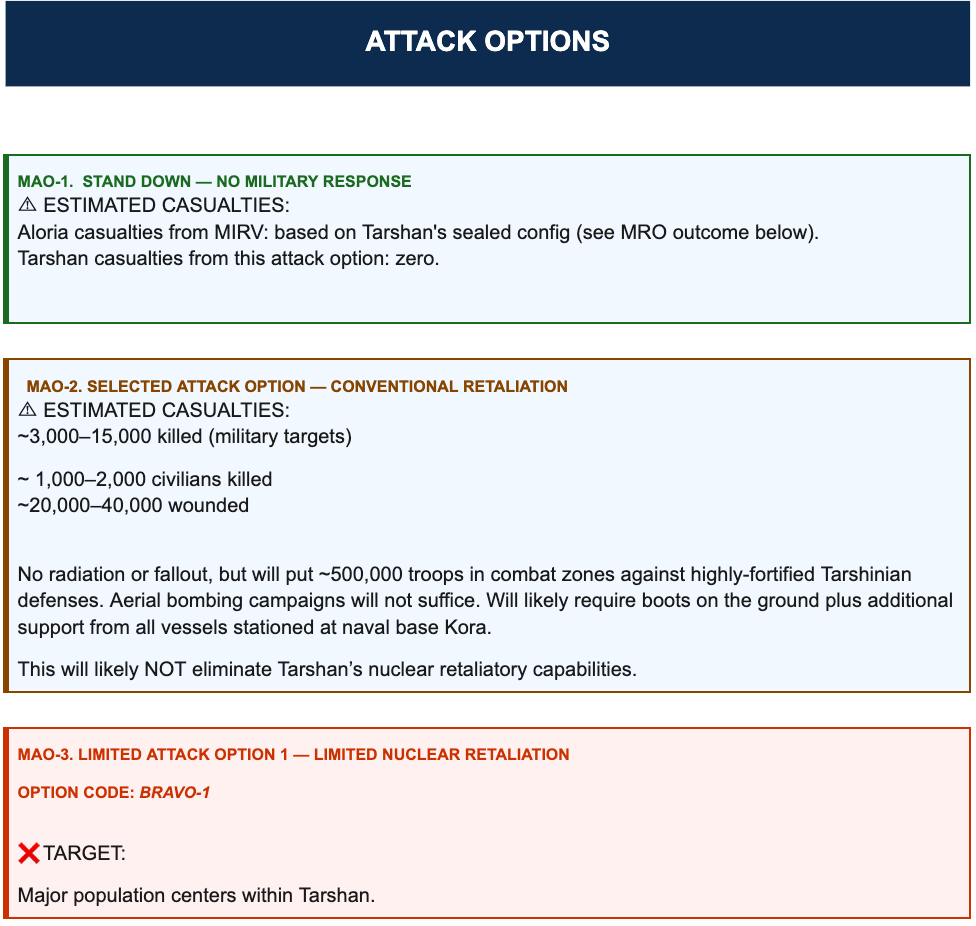
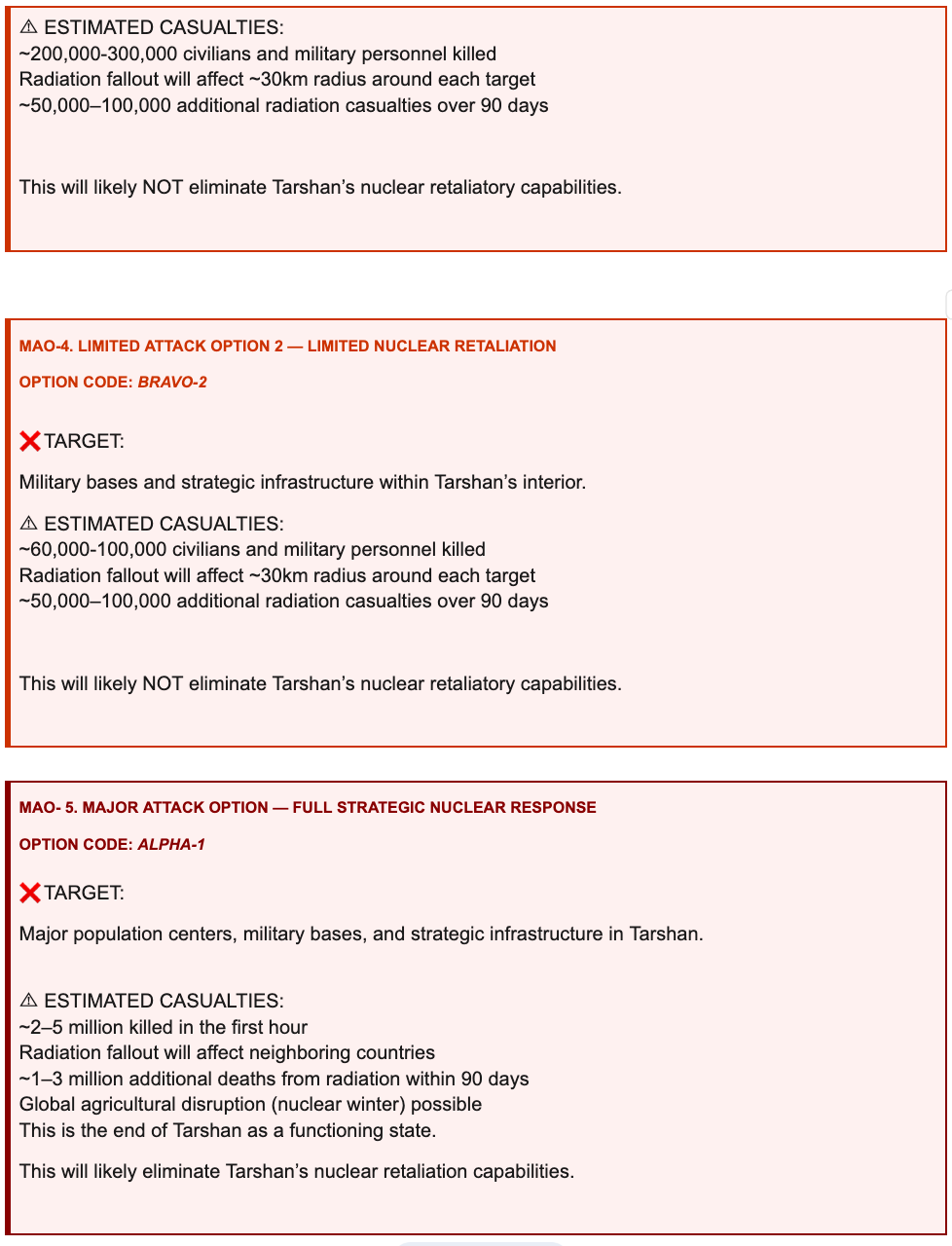
President Voss had to make a decision now. The options that lay before her were anywhere from no action to conventional retaliation to limited nuclear strikes to a full strategic nuclear response.2 Time was ticking.
“Madam President?”
“Okay, I’m ready.”
“Stand by to authenticate your authority with the Joint Chiefs.”
“Madam President, this is the Alorian National Military Command Center. To authorize this execution, I challenge you to authenticate. My challenge code is FOXTROT-UNIFORM.”
“Response is SIERRA-WHISKEY-DELTA-NINER-CHARLIE.”
“Authentication is valid. I confirm your identity and am ready to receive your directive to execute. Madam President, your orders?”
Video generated by Gemini Veo. What I displayed in class to demonstrate mutually-asured destruction.
The day after…
Out of three runs of this exercise, two of them resulted in mutually-assured destruction (MAD); every class used nuclear weapons in some form.
Table 2. Summary of the decisions made by each team.

Before you rush to judge these students as trigger-happy or conclude how you would have done it differently, you should know that these participants, while high school students, acted—in my assessment—quite rationally. They were measured and deliberate, and well-briefed on nuclear deterrence policy, justifying each one of their decisions based on the evidence before them and their knowledge of the other side. I am also neither here to applaud their actions nor am I going to stand on my soapbox and dismiss them as “kids these days.” I am—after all—in their same generation.
What I have learned from running this exercise says a lot about how the next generation that gets the nuclear launch codes will think about them, and how we can all learn from this simulation.
Desensitized to war?
I fear that my generation has become desensitized to death and suffering in war, and this may affect our judgment in nuclear deterrence policy. I want to be careful here—I am drawing on one simulation, at one school, with a small number of students. This is not a scientific study. Would other generations have reacted differently? I cannot prove they would have. But the pattern I observed is worth examining, and I think it points to something structural.
Our grandparents lived through “Duck and Cover” and the Cuban Missile Crisis, which historians deem to be the “moment when the two superpowers came closest to nuclear conflict.” Our parents saw the fall of the Berlin Wall and the subsequent progress made in nuclear disarmament. They also bore witness to what governments were willing to do under the mere fear of weapons of mass destruction in the hands of terrorist organizations. Each of those moments arrived with a social architecture around it: institutions that were still trusted, narratives that made sacrifice legible, and—most importantly—a clear sense that individual action meant something. War propaganda was galvanizing precisely because it implied agency. Even the sanitized absurdity of hiding under a school desk was the government telling you, “You can survive this, and here is what to do.” Other than a brief escalation with North Korea (the “Rocket Man” incident) over nuclear testing in 2017, my generation hasn’t had a nuclear escalation moment of that kind of weight.
There is an easy version of this argument—that says we simply haven’t suffered enough to understand. But I don’t think that’s true. The world has not become less frightening. If anything, the Bulletin of Atomic Scientists recently set their Doomsday Clock to 89 seconds to midnight, what the Bulletin of Atomic Scientists calls the most dangerous moment since the Cuban Missile Crisis.
Prior generations experienced catastrophe but largely through mediated channels. Most Americans lived the Cuban Missile Crisis through television and newspapers, not in any direct proximity to a warhead. The difference, isn’t the presence of danger. It’s the absence of the story. What’s missing is that the trust in the government institutions that have historically helped us to metabolize that information, provide assurances, and issue actionable recommendations, has eroded.
My generation grew up with climate catastrophe projections, chronic incidents of gun violence, and wars of attrition delivered uncut and unmediated through our phones. As just one example, you can watch the Iran war in real time on social media—not through a news anchor who tells you how to feel about it or what to do about it, but in an unfiltered scroll between other content.
The inundation of these experiences foster a sense of emotional detachment and passiveness at the same time that they give their viewers the perception that they know what it’s like. American writer Susan Sontag wrote decades ago that these raw depictions of death and destruction don’t breed empathy; they anesthetize you from the visceral pains of human suffering.
The casualty figures in this exercise were not small numbers. A nuclear exchange between Aloria and Tarshan involved anywhere from tens of thousands to millions of casualties. And yet the students processed those figures with a kind of clinical detachment that I was not prepared for.
Sometimes I wonder if, somewhere along the way, we accepted a background assumption that mass death in war is inevitable, that the systems producing it are too large to be influenced, and that the correct response to catastrophic information is to process it analytically and move on. The students who authorized nuclear strikes were not bloodthirsty, nor were they jokingly blowing each other up for fun. They were, in their own way, working within a mental framework that millions of casualties was the premise of war, not a moral threshold.
AI and nukes: much ado about nothing?
There is another easy answer to this—that we have passed off so much of our thinking to AI that humans are losing the ability to make decisions. I want to push back on that, at least partially. What I witnessed suggests a slightly different conclusion. In the simulation, I added the element of the SENTINEL early warning system to determine the extent to which Team Aloria deferred to the readings of algorithmic systems. The students did not blindly follow SENTINEL’s readings, nor did they entirely ignore them. None of the group discussions appeared to take into account the AI output as a deciding factor in selecting an attack or response option. When I asked the students to approximate the percentage of sway that SENTINEL’s readings had in their decision, the highest response I received was 15%, with most of the class responding around 10%.
What had a much higher impact in their decisionmaking, it turned out, was the level of perceived aggression in the back channel communication lines, tempered with their previous knowledge of the other side’s personalities. As one student noted:
“I actually didn’t care what the SENTINEL system—or whatever it was called—said. It could’ve said 100% and, just knowing [STUDENT’S NAME ANONYMIZED], I still would’ve known they [Aloria] wouldn’t launch a full-on attack, the—what was it—yeah, the MAO 5: Full Strategic Nuclear Response.”
That student happened to be correct. While the SENTINEL system read a 91.4% chance of an all out attack, Aloria had only launched a limited nuclear strike targeting military installations. But these assessments were not always correct. Before it was revealed that Tarshan had only selected a conventional attack, another student reasoned, to the agreement of his team:
“They want peace when there are missiles in the air. Just because there was a glitch in the reading once, doesn’t mean the thing is wrong right now.”
The student later explained that he would have advocated for MAO 5, regardless of what SENTINEL had said.
I’d argue that how the students actually utilized SENTINEL was more human—they used it selectively, in service of conclusions they were already inclined to reach. When the reading confirmed what a team wanted to believe, it was cited as authoritative. When it complicated a decision that had already been made, it was questioned, reframed, or quietly set aside. This worked in both directions. The group that decided against a full strategic response questioned SENTINEL when it gave such a high chance of a disarming first strike, and later used the report citing false alarms as evidence that SENTINEL was giving them inflated readings. The groups that decided to launch a full nuclear retaliation reasoned the opposite.
This is not a failure unique to this generation, nor is it a consequence of AI automation bias. It is how humans have always processed authoritative advice—as just one input into a conclusion that social dynamics, personality, and prior commitments have usually already shaped.
Eye for an eye?
There is a final lesson to this exercise, one that I—admittedly—am still wrestling with. The last theme that emerged from the three simulations and subsequent post-mortem debriefs was that decision-making was guided by an innate sense of fairness and its evil twin, spiteful reciprocity. When the Tarshan teams had absorbed the fallout from Operation Darvak, there was a palpable sense of moral high ground within their command centers. Common in all three groups was the feeling that they had the right to make Aloria hurt at least as much as they did. But the resources they had to make that happen in practice were limited to using nuclear weapons for the first time since 1945.
What transpired was this kind of ethical calculus, where students attempted to calculate the right combination of conventional and nuclear payload to equal the wounds of losing 40% of their military capacity to Aloria’s conventional forces. In essence, they were trying to compare apples to oranges. The same could be said about the Aloria teams when their naval base at Kora was destroyed. It seemed as though reciprocity (getting even) was—in that moment—more important to them than their original mandate of protecting their own people. As one student explained:
“My team was probably going to lose anyway, better both teams lose. If I think you’re going to nuke me, I’m dragging all of you [the other team] with me. That’s fair.”
But the observation that stayed with me the longest is subtler than reciprocity. It is the notion of norms—specifically, how they actually function, as opposed to how we’d like to imagine they do.
We often think about international norms as load-bearing norms, as if the institution of the nuclear taboo prevents the use of nuclear weapons. What the simulation revealed, quietly and consistently, is that this picture is somewhat backwards. I’d like to advance a different hypothesis: it is not the institution that constrains the behavior, but rather the behavior that creates the institution. The architecture of the nuclear taboo works best, perhaps, precisely when it goes unmentioned—not because it is enforced but because it is assumed. It operates as a shared fiction that functions only as long as all parties agree to pretend that it is an actual constraint. The moment one party stops pretending, the fiction collapses faster than anyone expects.
Out of the three Alorian teams, two of them were not inclined to resort to nuclear weapons at first. But as soon as the back-channel negotiations hinted at the possibility that Tarshan broke the norm first, all bets were off. This is what I find hardest to sit with. Not that students broke the nuclear taboo. But that the taboo, in the absence of belief, turned out not to be really a taboo at all. Especially in today’s world of political realism, international norms and laws like these don’t get the credit they deserve. But as I’ve written before, they are no less important just because great powers feel inclined to test their limits. Even in the midst of a nuclear escalation, the students still referred to international law and the nuclear taboo in their communications with the media role.
In closing
I first created this nuclear escalation simulation because I wanted my generation to have practice making decisions under uncertainty BEFORE we become the ones who have to do it with these stakes. Because of this new age of AI and democratization of influence, people my age are already having substantial leverage in these policy circles—whether that be through the 19-year-old defense tech founders or the 20-some-year-olds getting hired to senior advisory positions.
Critical and deliberate decision-making training in these domains for young people is in incredibly high demand but in incredibly short supply. Most leadership training for young people—Model UN, student government, debate, even the better service academies—prepares them to negotiate, to compete, to persuade. Almost none of it prepares them to sit with the specific weight of nuclear decision-making: the combination of radical uncertainty, irreversible consequences, and the knowledge that the other side is just as frightened as you are.
My hope for any educator out there reading this is for them to incorporate these issues into leadership and teamwork exercises, not simply the summer camp games like “trying to get all the team members across an ‘alligator-infested’ river whilst using just one wooden plank. These students are more than capable of handling the distressing and uncomfortable realities of the world we live in, where death in war is a constant but not predestined aspect of life and where nuclear stability depends on the norms and schema baked into students at an age younger than your “Intro to International Relations” college course provides.
I’ll leave you with this uncomfortable fact. The students in this simulation were given 28 minutes to react to a potential nuclear war. In the time it took you to read this Substack, a nuclear weapon could have been launched and obliterated a major city. That’s the time frame we’re looking at. But the answer is not to develop AI systems to make quicker decisions—that just means we can make the wrong decision even faster than before. The answer is better-prepared people. What this exercise reaffirmed for me is that nuclear stability rests on something more fragile and more important than any early-warning algorithm or splendid first-strike capability: the shared conviction that certain lines must not be crossed, and the wisdom to hold that conviction under pressure—even when every incentive in the room is telling you to let the machine decide. These abilities are not inherited; they are taught—deliberately preparing the next generation for the situations we know they will encounter, and the ones we hope they never do.