



BLUF
The New START Treaty—the last remaining nuclear arms treaty between the U.S. and Russia—is set to expire in four days. Given the state of U.S.-Russia tensions, China’s nuclear modernization, and ongoing threats from Iran’s nuclear development, the world will become a more dangerous place without New START. This won’t be due to explosive nuclear action but a quiet inaction on nuclear disarmament agreements.
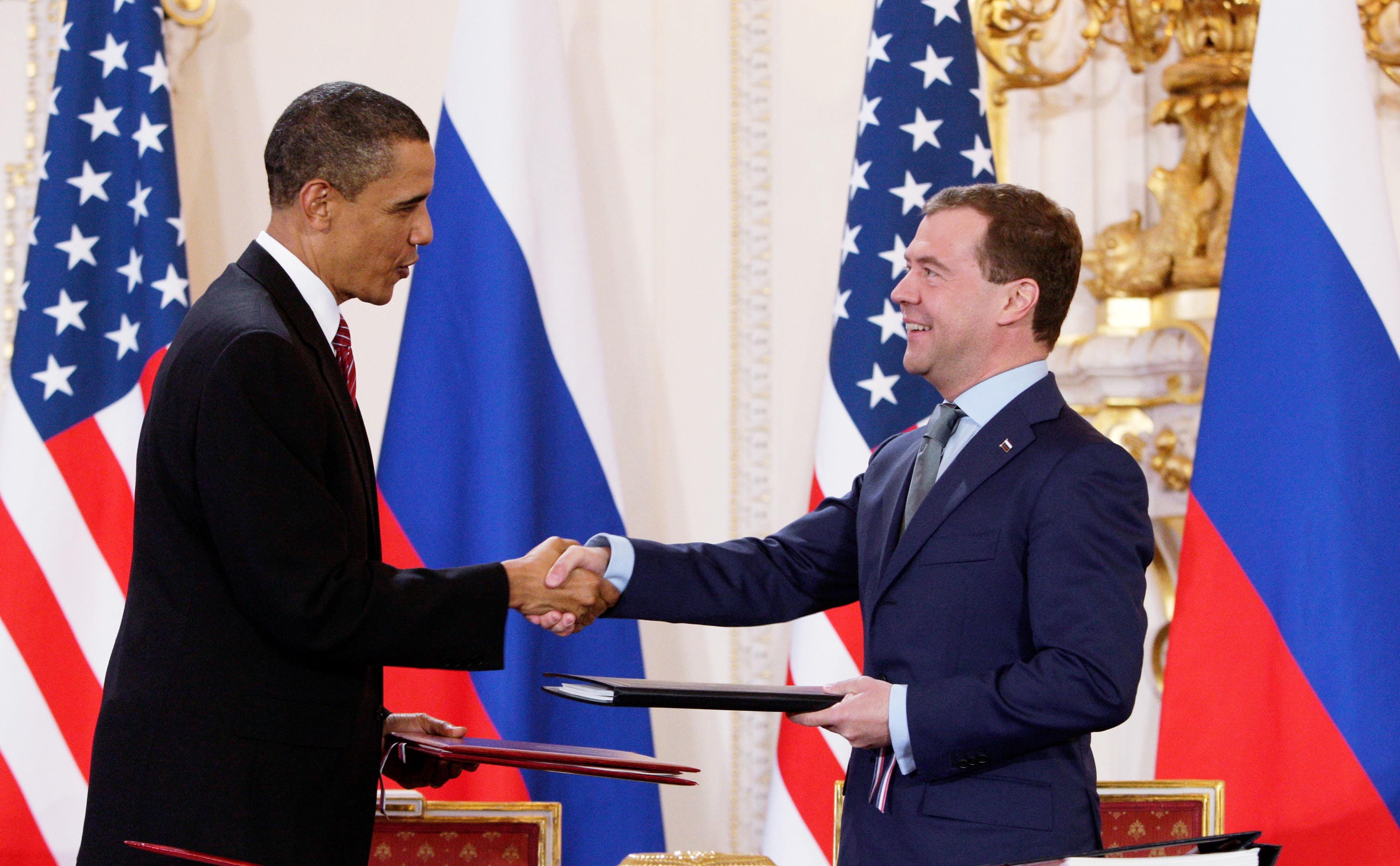
Graphic: Obama and Medvedev sign the Prague Treaty 2010, Wikimedia Commons
What is New START?
The New Strategic Arms Reduction Treaty, or New START, is a treaty between the United States and the Russian Federation designed to reduce and limit each nation’s strategic offensive arms. It does so by putting a cap on intercontinental-range nuclear weapons, limiting the U.S. and Russia each to:
700 deployed intercontinental ballistic missiles (ICBMs), deployed submarine-launched ballistic missiles (SLBMs), and deployed heavy bombers equipped for nuclear armaments
1550 nuclear warheads on these ballistic missiles and bombers
800 deployed and non-deployed ICBM launchers, SLBM launchers, and nuclear-equipped heavy bombers
New START also outlines verification mechanisms to ensure compliance on both sides, which include 18 annual onsite inspections, extensive data exchanges, notification requirements for changes in force deployment, and confidence-building measures.
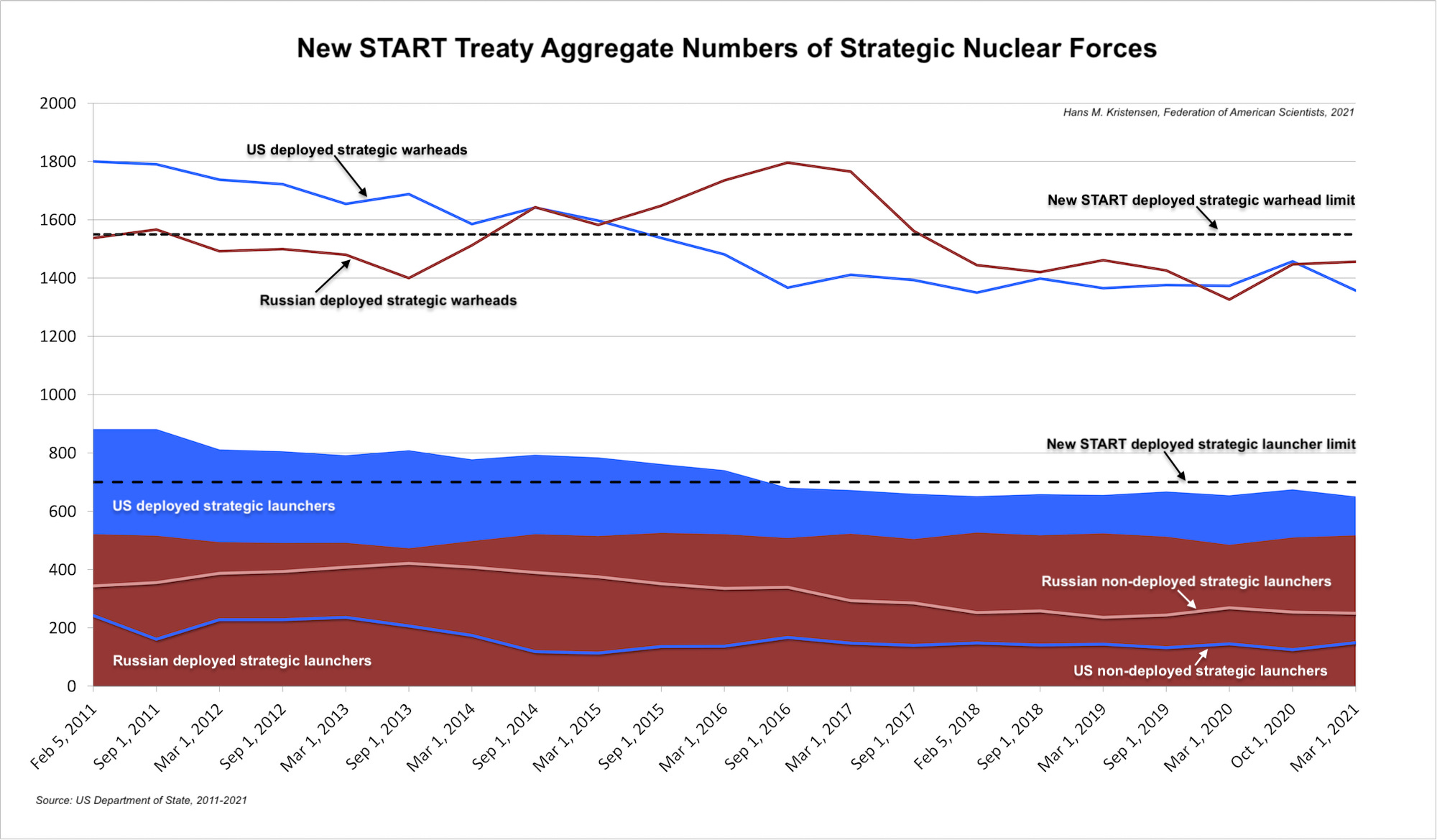
Graphic: Federation of American Scientists
New START reduced the U.S. nuclear stockpile by ~1300 warheads, while Russia’s nuclear arsenal declined by nearly 1000 warheads. Following the expiration of the START I treaty in December 2009, New START entered into force on February 5, 2011. It was in place until February 3, 2021, when both sides agreed to its optional five-year extension until February 5, 2026. New START remains the only nuclear arms agreement between the U.S. and Russia, and it has recently been strained.
Where is New START now?
Following the full-scale Russian invasion of Ukraine in February 2022, Russia suspended U.S. onsite inspections of its nuclear arsenal, citing Ukraine War-related sanctions that allegedly prevented their inspectors from traveling to the U.S. The U.S. State Department reported in November 2022 that its Russian counterparts were unilaterally postponing nuclear arms talks without reason.
Then, on February 23, 2023, in his annual Presidential Address to the Federal Assembly, Russian President Vladimir Putin announced that Russia would suspend its participation in New START. Rose Gottemoeller, the State Department’s chief negotiator for New START, and Marshall Brown Jr., the legal advisor to the New START delegation, criticized this move as impermissible by the terms of the treaty and international treaty law.
While committing to abide by the treaty rules on nuclear deployment limits, Russian senior officials soon suspended all notifications on nuclear activities, as required by the treaty, saying:
“There will be no notifications at all. All notifications, all kinds of notifications, all activities under the treaty, will be suspended and will not be conducted regardless of what position the U.S. may take.”
Finally, on June 2, 2023, the United States formally revoked the visas of Russian nuclear inspectors, citing the move as a lawful countermeasure to its treaty noncompliance.
With New START set to expire in four days, there has been very little discussion of any extensions. Putin proposed a one-year extension to the treaty back in September, but it doesn’t seem to have led to anything concrete. And unless a last-minute agreement is reached, the last remaining arms reduction treaty between the two nuclear superpowers will lapse quietly in the background—the risks of this happening should not be overlooked.
What happens if New START…ends?
New START will lapse at perhaps one of the worst times for U.S.-Russian relations. For all his talk about denuclearization with Russia, President Trump’s actions are at odds with this view. For one, he seemed relatively blasé about the impending expiration of New START, saying, “If it expires, it expires. We’ll do a better agreement,” and expressing confidence in his ability to quickly negotiate a new agreement. At the same time, House lawmakers like Brian Mast and Keith Self are in favor of moving past New START to develop a new arrangement that includes China’s nuclear modernization. Meanwhile, Putin’s offer of the one-year extension still stands, but he has not made any public comment about it in the past week. So, what happens if New START expires?
Nuclear warhead limitations may remain, but only voluntarily
New START’s expiration won’t necessarily lead to full-blown nuclear proliferation. After all, Putin expressed appetite to extend the terms of the treaty for a year. In his calculus, it may not be the best decision to proliferate. The War in Ukraine has become a protracted war of attrition, one which tactical nuclear weapons wouldn’t yield significant territorial gains for Moscow, and which strategic nukes (which New START limited) wouldn’t be relevant.
Furthermore, the Trump administration has expressed that peace in Ukraine and subsequent security guarantees would be contingent on ceding territory to Russia. Putin is in a good spot with the Trump administration—knowing President Trump’s capricious attitude towards Russia, it would not be a strategically advantageous move to inflame nuclear tensions with the U.S. at the risk that Washington begins supporting Kyiv more vigorously.
However, this is not to say that nothing will happen. New START provided an explicit, verifiable, and structural constraint on American and Russian nuclear behavior. Making proliferation and deployment decisions based solely on strategic value and voluntary signs of goodwill is not a good thing. Without formal constraints on nuclear stockpiles and vehicles, the possibility of buildups and arms races hinges on the vicissitudes of the current geopolitical climate, which is shaky at best.
New START didn’t actively force the U.S. and Russia to comply with its terms, as shown by Russia’s suspension in 2023, but it did make defection and switching costs incredibly high. Without the treaty in force, each side’s nuclear postures and stockpiles could change at the drop of a hat. Additionally, there is no legal signpost to which the other side can point to shame the nuclear proliferator; they can—dangerously—just proliferate themselves in response.
Risks of a nuclear arms race
The risks of a nuclear arms race will always exist between the U.S. and Russia, but the impetus for proliferation in the U.S. may come from an additional source: China. Since New START entered into force, the number of China’s nuclear warheads has increased by 150%, and the People’s Liberation Army (PLA) has worked diligently to modernize its nuclear arsenal, projecting that it will reach qualitative and quantitative parity with that of the U.S. by the mid-2030s.
China hawks in U.S. think tanks and in Congress have argued against extensions on New START, less so because of the changes to the U.S.-Russia relationship but rather because of the constraints it would place on Washington’s ability to compete with China. For example, the Heritage Foundation argues that the U.S. should actually add nuclear warheads to its stockpile to counter China’s nuclear force. Furthermore, its Project 2025 advocates for the U.S. to reject the ratification of the Comprehensive Test Ban Treaty and engage in nuclear testing if necessary. The Trump administration seems amenable to this posture, announcing back in October that the U.S. would resume nuclear testing to keep pace with Russia, China, and North Korea.
“Imagining that a meaningful arms-control agreement with Russia will emerge after the expiration of New START early next year amounts to wishful thinking. There is simply no good deal to be had at this point. Instead, it would be far better for the United States to create the leverage it needs by fielding a more robust and credible nuclear deterrent. Only that kind of pressure can incentivize both Russia and China to come to the negotiating table at the same time, allowing all three nuclear superpowers to attempt to negotiate a more meaningful and effective agreement.”
- The Heritage Foundation, September 10, 2025
Meanwhile, China hawks in Congress, most notably Mississippi senator Roger Wicker, have vowed to work with the Trump administration to rebuild military strength to counter China’s buildup of intercontinental ballistic missile launchers. The pre-New START, Cold War logic was that a stable environment was one in which the U.S. and Russia had nuclear parity. But now, the incentive could shift more towards the U.S. having parity with the combined nuclear muscle of Russia and China. This, in and of itself, could spark subsequent and retaliatory buildups.
Risks of entanglement
Finally, the U.S. has dipped its foot into conflicts all across the globe, despite its purported return to “Monroe Doctrine” priorities. The New START treaty not only put Russia’s mind at ease over potential proliferation, but it also provided a degree of informal reassurance to non-nuclear states like Iran that the costs of establishing a nuclear weapons program would outweigh the benefits. With unfettered nuclear proliferation, the Ayatollah’s calculus might change.
Damage assessments of U.S. strikes on Iranian nuclear facilities last year showed that nuclear enrichment could resume in only a couple of months if Iran wanted to. And while Israeli strikes also killed many of Iran’s top nuclear scientists, it certainly did not prevent Iran from continuing its nuclear developments. Satellite imagery in late January 2026 showed efforts to salvage materials from bombed sites, and reports from last December reveal suspected attempts from Iran to harden its nuclear program against future U.S.-Israeli strikes.
Why does this matter? Even if the U.S. builds and modernizes its nuclear arsenal in the name of competing with China, it still presents a threat to Iran. If Tehran perceives it this way, it may incentivize a race to develop a nuclear weapon that will deter Washington and Tel Aviv from aiding Iranian protestors via military intervention.
On January 27th, 2026, the Bulletin of Atomic Scientists set the Doomsday Clock at 85 seconds to midnight, marking the closest the world has come to global catastrophe from man-made technologies. In a statement, its Science and Security Board cited the expiration of New START as one of the factors that contributed to that assessment.
We often forget the tension that the Cuban Missile Crisis brought—back then, we were seven minutes to midnight. Yes, I’ve heard all the criticism about how the Doomsday Clock is all relative and “how can we actually be closer to armaggedon now than during the Cuban Missile crisis?” But we don’t live in a bipolar world anymore, and since 1962, four (five if you include Israel) more nations have acquired nuclear weapons. The U.S. and Russia are the nuclear powerhouses, and like it or not, their actions on nuclear proliferation will either strengthen or weaken the protective norms of the nuclear taboo. And it’s up to them which side the coin will land on.


