



BLUF
The 2026 Munich Security Conference highlighted a shift toward “wrecking-ball” politics, where the U.S. favors dismantling the traditional rules-based order in favor of a more transactional, “personalist” approach. In response to American volatility and issues like the diplomatic rift over Greenland, European and Indo-Pacific nations are pursuing “strategic realignment” and “double-hedging” to secure their own interests. This includes major initiatives like the India-EU trade deal, the “middle corridor” in the Caucasus, and the controversial “Board of Peace” for Gaza. Ultimately, the conference signaled a global acceptance that the old international order has receded, forcing a new focus on regional hegemony and self-sufficiency.
Graphic: Wikimedia Commons
“Wrecking-ball” politics
Perhaps unsurprisingly, the spotlight was on evaluating the effects of the first year of the Trump administration’s second term on international geopolitics, international law, and the rules-based international order in general. Since Vice President JD Vance’s cutting remarks at the conference a year ago, the 2026 Munich Security Report describes President Trump as a “demolition m[a]n,” someone who believes that meaningful change in foreign policy requires a complete scrapping and reworking of the current rules-based international order in favor of more personalist, more dynamic, “move fast and break things” approach. This “wrecking-ball” approach to foreign policy is evident in President Trump’s military strikes in Iraq, Iran, Nigeria, Somalia, Syria, Venezuela, and Yemen; his recent push to acquire Greenland; and his withdrawal from the Paris Climate Agreement and the World Health Organization.
At this year’s conference, Secretary of State Marco Rubio drew a more nuanced line and tried to reaffirm the U.S.-European partnership in his keynote address: “For the United States and Europe, we belong together,” he stated, “We are part of one civilization – Western civilization.” But he also stressed the need for a degree of self-sufficiency, reciprocity in defense partnerships, and direct action against those who “endanger our global stability” and “shield themselves behind abstractions of international law which they themselves routinely violate.”
“And so this is why we Americans may sometimes come off as a little direct and urgent in our counsel. This is why President Trump demands seriousness and reciprocity from our friends here in Europe. The reason why, my friends, is because we care deeply. We care deeply about your future and ours. And if at times we disagree, our disagreements come from our profound sense of concern about a Europe with which we are connected – not just economically, not just militarily. We are connected spiritually and we are connected culturally.”
~ Secretary of State Marco Rubio, February 14, 2026
So, besides the elephant in the room, let’s get down to brass tax. The big trends are clear: fracturing rules-based international order, middle power hedging, etc. But what were the specific topics of conversation?
The issues in a nutshell
Europe: Greenland, hybrid warfare, strategic realignment, and nuclear deterrence
Despite reaching a “framework of a future deal” on Greenland in January 2026, the diplomatic spat between the Trump administration and Denmark prompted Danish intelligence to explicitly label the U.S. approach a threat to Arctic sovereignty. The increasingly fraught relationship between Washington and the EU has provoked a feeling of uncertainty on the extent to which the U.S. would defend European interests, leading many European leaders to rethink how to secure avenues of collective security in a post-NATO world. For instance, French President Emmanuel Macron stated that France would play a bigger part in deterrence, and analysts believe this may signal the potential of an extended nuclear umbrella to other European nations. The Munich Security Conference was a full-on display of French leadership on defending Ukraine, fending off economic coercion, and possibly replacing the U.S. as Europe’s nuclear security guarantor.
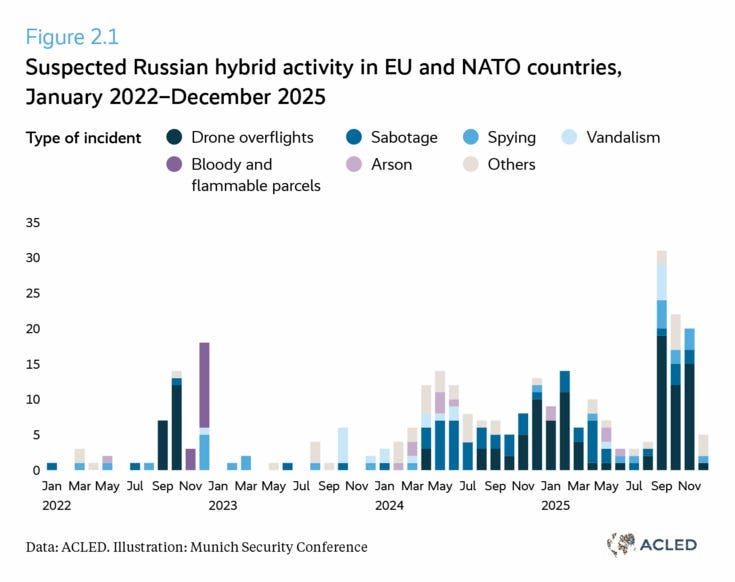
Russia continues to be the most immediate threat to NATO and European security. Aside from the war of aggression in Ukraine, conference participants also further emphasized Russia’s tactics of hybrid warfare. These acts include sabotage, vandalism, cyberattacks, and arson. For instance, Moscow has reportedly been subjecting the Baltic Sea Region to GPS signal jamming and spoofing, which have disrupted airline travel, among other industries.
The past year has reflected a gradual realization by European states that they must be responsible for their own security and economic prosperity, and they have been actively taking steps towards this strategic realignment. Germany, for one, recently announced a €80B rearmament spending package to build its defense industrial base, to which American weapons only account for 8%. Additionally, the EU and India concluded a massive trade agreement in January 2026, which accounts for 25% of the world’s GDP. Europe is pivoting, but the extent to which it is free from U.S. economic and military paternalism remains to be seen.
Asia: Double-hedging in the Indo-Pacific, economic corridors in the Caucasus
Like Europe, key actors in the Indo-Pacific theater are uncertain about the strength and commitment of the U.S. partnership. The result is a kind of “double hedge,” in which these nations try to both align themselves with both of the great powers (the U.S. and China) on one side, and align themselves with each other to mitigate the fallout from a great power clash on the other. On one hand, countries like Vietnam, Thailand, Japan, and South Korea are willing to work with the U.S. for their own economic survival by rebalancing their terms of trade, cracking down on transshipment, and investing in the U.S. On the other, Trump’s capriciousness on his relationship with them and his relationship with Xi Jinping have severely decreased the incentive to take a hard line on China, even when their partnerships with Beijing come at the direct expense of the U.S. For instance, ASEAN has been aligning with China more closely on economic security, as demonstrated by their upgraded free trade agreement last October.
In central Asia and the Caucasus, easing diplomatic relations between Armenia and Azerbaijan has opened up the opportunity for new economic partnerships. On the sidelines of the Munich Security Conference, foreign ministers gathered to discuss the promise of a so-called “middle corridor,” an economic trade route connecting East Asia to Europe via Kazakhstan, in order to secure connectivity, diversified energy, and resilient supply chains. Again, this demonstrates strategic rebalancing efforts on display in Munich.
The Middle East and Africa: Peace talks and the emergence of regional hegemons
The first order of business at Munich 2026 was the Board of Peace and the governance of Gaza. The board is designed to oversee the disarmament of Hamas, the deployment of an International Stabilization Force, and reconstruction. Permanent seats are reportedly tied to a $1 billion contribution toward Gaza’s rebuilding. But the conference also exposed internal rifts in how Gaza’s reconstruction should be carried out. EU Foreign Policy Chief Kaja Kallas and Spanish Foreign Minister José Manuel Albares criticized the board for bypassing the UN and Palestinian agency, describing it as a “personal vehicle” for the U.S. President rather than a legitimate multilateral body.
Meanwhile, there was also a focus on emerging regional hegemons and their role in the nexus between climate and security. On the sidelines of the conference, the Global Center on Adaptation released a report detailing how increasing water scarcity is driving conflicts in the Sahel and Horn of Africa. Regional hegemons, such as the UAE and Saudi Arabia, may start to emerge in the MENA region, not only by how they present themselves at leaders’ summits like the Munich Security Conference, but also how they demonstrate leadership on issues like climate change-induced conflict (e.g., Darfur Water Conflict) and territorial sovereignty (e.g., Somalia-Somaliland Dispute).
In previous security conferences, there was an ambience of “the current international order is under threat. What can we do to shore up the international system?” At Munich 2026, there was a notable break from that rhetoric. When listening in on the panel discussions, roundtables, and keynote addresses, I found that the main theme was “Okay, the rules-based international order as we know it is no longer a thing. Now that we have all acknowledged that, what should we do now?” It’s a slight change in messaging, but one that has significant implications for how trade deals are negotiated, how conflicts are settled, and how international security is defined. The title of this year’s conference was “Under Destruction.” I find that title befitting of the moment.


