



BLUF
Recent reports and statements from President Trump signal a weakening dollar. The U.S. dollar maintains its status as the world’s reserve currency, granting the U.S. the power of effective economic sanctions and the privilege of low borrowing costs. However, this position also demands balancing domestic stability with the global need for dollar liquidity, all while navigating the risks of a volatile exchange rate. Current 2026 policies favoring a weaker dollar aim to boost domestic manufacturing and narrow the trade deficit, but they risk eroding international confidence and inviting “de-dollarization” by adversaries and allies alike. Ultimately, a significant loss of reserve status would cripple Washington’s ability to fund massive deficits and signal an end to U.S. economic unilateralism in international security.
Graphic: Stock market trend; http://creativecommons.org/publicdomain/zero/1.0/
The dollar as the global reserve currency
Before the 20th century, the British Pound Sterling was the global reserve currency due to Great Britain’s dominant position in global trade. However, following the end of the two World Wars, the United States was the only major economy that was not completely devastated by the war. With the overvaluation and subsequent decline of the pound, combined with the fact that the U.S. held most of the world’s gold reserves, the dollar continued to strengthen. At the 1944 Bretton Woods Conference, held to establish the post-war economic order, the United States officially became the global reserve currency, pegged to gold at $35 per ounce. When President Richard Nixon ended the dollar’s convertibility to gold in 1971, its value instead became pegged to a floating exchange rate backed by the full faith and credit of the U.S. government.
To this day, the USD remains as the global reserve currency, in large part due to its deep liquid financial markets, utilization in global commodities trading (most notably in oil), and—simply—because everyone else is trading in dollars, raising “switching costs.”
Exorbitant privilege
Most of the world’s central banks hold a significant portion of their foreign exchange reserves in U.S. dollars to back their own currency and pay off international debts. This “exorbitant privilege,” as first described by France’s financial minister in the 1960s, allows the U.S. to borrow at lower interest rates than foreign central banks would otherwise allow. It also means that the U.S. government and American firms can borrow money in USD instead of foreign currency, saving money on transaction costs and making their loans less susceptible to fluctuations in the exchange rate, which could make foreign borrowers’ debt increase.
Exorbitant power
Currently, the dollar accounts for 56% of global foreign exchange reserves, 54% of export invoicing, and a staggering 89% of foreign exchange transactions. Its central role in the global economy also means that most international transactions must deal in USD at some point, especially if using SWIFT, a global messaging system used to communicate instructions for international monetary transfers. That’s leverage.
The U.S. Treasury Department’s Office of Foreign Assets Control has enormous power to issue economic sanctions, freeze foreign assets, monitor cross-border transactions, and kick adversaries off the SWIFT system. Examples include blocking the Russian Federation and affiliated firms from accessing frozen assets via the SWIFT system after Putin’s invasion of Ukraine in 2022, or imposing foreign asset controls on Cuba in 1963. Economic sanctions backed by the USD reserve currency have surged ninefold in the past two decades, a sign of its power in obliging foreign policy actions. But with exorbitant power comes exorbitant responsibility.
Exhorbitant resposibility
Because the global economy depends on the constant supply of USD, the U.S. must persistently run a trade deficit for other countries to keep global trade moving and hold in their reserves, but if it ran an excessive deficit, it would undermine confidence in the dollar as the global currency. This delicate balancing act, known also as the Triffin dilemma, is made more difficult by the fact that people tend to dump foreign assets and purchase U.S. treasuries in times of economic turmoil, inflating the value of the dollar, making American-made goods more expensive, and threatening American job stability.
In addition, the U.S.’s decision on interest rates reverberates throughout the global economy more than other currencies. When the Fed tries to fight inflation by adjusting interest rates, it can inadvertently spur debt crises in emerging markets. Thus, the Fed must sometimes choose between domestic stability and global financial stability.
Strong dollars vs. weak dollars
A strong dollar is good for American importers and consumers of foreign-made products, but it also makes American goods more expensive for foreign buyers. A stronger USD also helps to curb inflation because American-made goods and services must be cheaper to compete with more economical imports.
On the flip side, a weaker dollar also has its benefits. Tradeable American goods and services become more affordable to foreign buyers, increasing U.S. exports. American shareholders of foreign stocks are happy with the appreciated returns, and the Trump administration can boast about the narrowing trade deficit. But bid that French wine adieu, and kiss that Italian cheese goodbye, as imports to the U.S. become more expensive.
International security implications for a devalued dollar
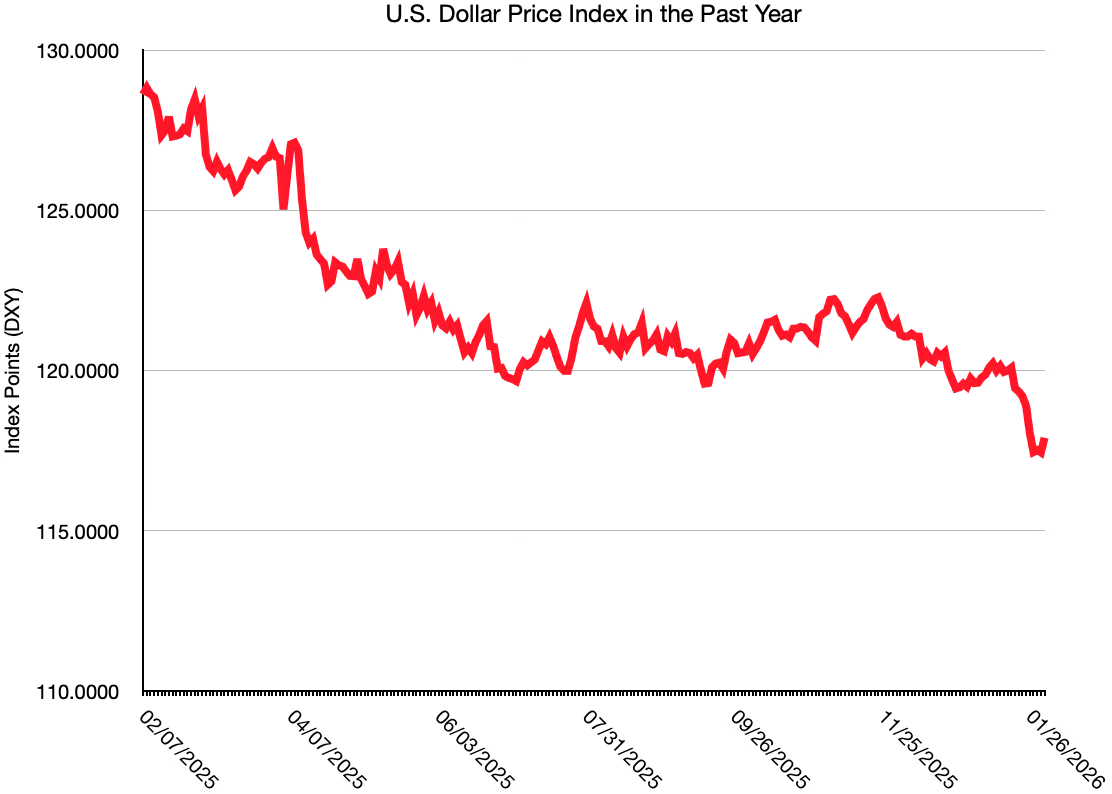
As early as his first term in office and as recently as February 2026, President Trump has signaled his preference for a weaker dollar. And since Trump returned to office at the beginning of 2025, the USD has dropped around 11 index points, around a 10% devaluation in the dollar compared to a basket of six major currencies (the Euro, Yen, Pound, Canadian Dollar, Swedish Krona, and Swiss Franc). In the past few months, Trump has repeatedly pressured the Fed to lower interest rates, imposed an aggressive reciprocal tariff regime, and used his bully pulpit to praise a weakening dollar.
It aligns with many of his priorities—fast growth, onshoring of manufacturing, and a smaller trade deficit. However, a weaker dollar means giving up ground on other areas that are also top of mind, most notably in foreign policy leverage.
“As your President, one would think that I would be thrilled with our very strong dollar. I am not! The Fed’s high interest rate level, in comparison to other countries, is keeping the dollar high, making it more difficult for our great manufacturers like Caterpillar, Boeing,.....”
~ President Donald Trump on X, August 8, 2019
First, a weak dollar reduces the coercive leverage of the United States to push on economic pain points. The efficacy of economic sanctions and export controls relies on the costs of noncompliance, which is being cut off from the dollar and thus the global transaction ecosystem. A weak dollar incentivizes countries to de-dollarize, making it easier for adversaries to bypass traditional sanctions regimes. Adversaries may no longer feel the economic bite of the U.S. when they violate international norms, and strategically autonomous countries may feel more comfortable resisting the heavy-handed nature of export controls. The extreme (albeit unlikely) case would look something like countries saying, “You know what, sanction us. We don’t care. We don’t carry that much USD anyway.”
Second, if the dollar weakens for an extended period of time, the U.S. runs the risk of countries losing confidence in the dollar. Such a scenario would severely hinder Washington’s ability to buy cheap debt and run enormous budget deficits, and the U.S. dollar’s status as the world’s reserve currency may yield to a different geopolitical power. As of November 2025, China settles roughly one-third of its foreign trade in yuan. A persistent weak dollar not only accelerates this trend, but it also provides a currency off-ramp for countries to jump ship and denominate their transactions in currencies other than the dollar.
With the rise of digital currencies, BRICS+ nations backing a BRICS currency and the yuan offering alluring alternatives, this would be a domino effect—countries hedging in different denominations, which would cause further collapse of the dollar as the reserve currency through devaluation, making yet more countries hop off the dollar and so forth. It’s a vicious cycle, much like how the pound sterling lost its sheen to make way for its American challenger more than eighty years ago.
In a presidential administration that accomplishes much of its foreign policy and economic statecraft goals through tariffs, losing the status of the world’s reserve currency would spell the end of U.S. economic unilateralism to get things done, for better or for worse. Money may not buy happiness, but it certainly buys influence through necessity. And whatever currency stands atop the rest, it will always be denominated in power.


