



For more context, listen to BLUF #9: Regime Change in Iran Will Require the Perfect Storm, but One Might Be Brewing:
BLUF:
On February 28, 2026, the United States and Israel launched a massive coordinated military campaign (Operations “Epic Fury” and “Roaring Lion”) that effectively decapitated Iran’s top leadership, confirming the deaths of Supreme Leader Ayatollah Ali Khamenei and several key military commanders. Following the failure of nuclear talks in Geneva and a massive U.S. naval buildup, the strikes targeted IRGC command centers, air defenses, and naval assets, prompting immediate Iranian retaliation against U.S. bases and Gulf allies. While President Trump has called for the Iranian people to seize this “hour of freedom” and overthrow the clerical regime, the path to successful regime change remains uncertain due to a burgeoning power vacuum, the lack of a clear U.S.-backed successor, and the risk of a protracted regional war involving Iranian proxies.
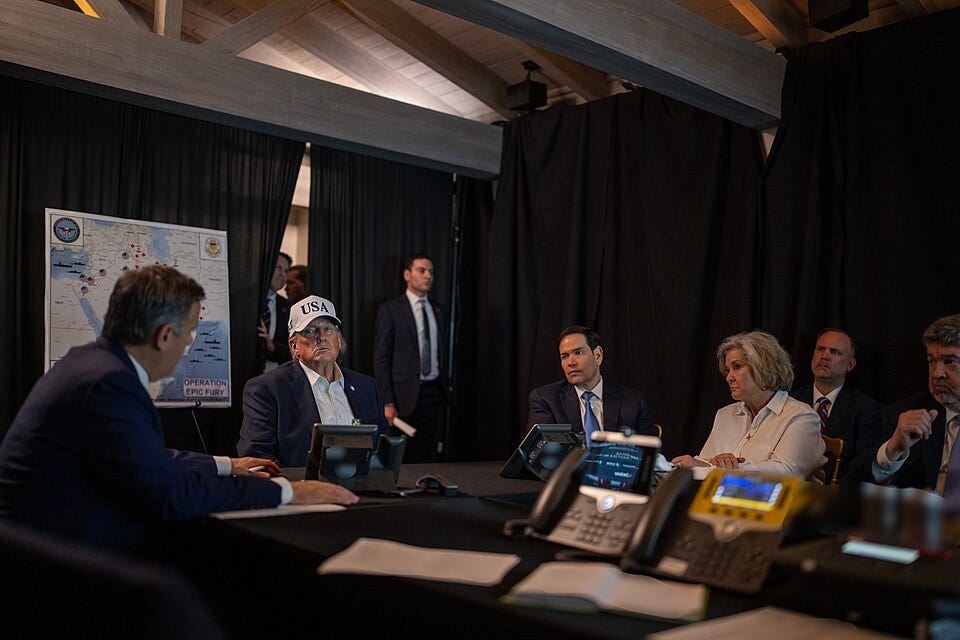
Graphic: President Donald J. Trump oversees Operation Epic Fury at Mar-a-Lago, Wikimedia Commons
What the heck just happened?
Following the deadliest protests in Iran since the 1979 revolution, President Trump pivoted his posture toward one of regime change. On January 23, he announced that the U.S. would send an “armada” to the Middle East, including the USS Abraham Lincoln, Tomahawk-missile-firing destroyers, and F-15E fighters. Throughout February, tensions between the U.S. and the Iranian regime escalated, with more military buildup from the U.S. in the Arabian Sea, Persian Gulf, Gulf of Oman, and Mediterranean Sea.
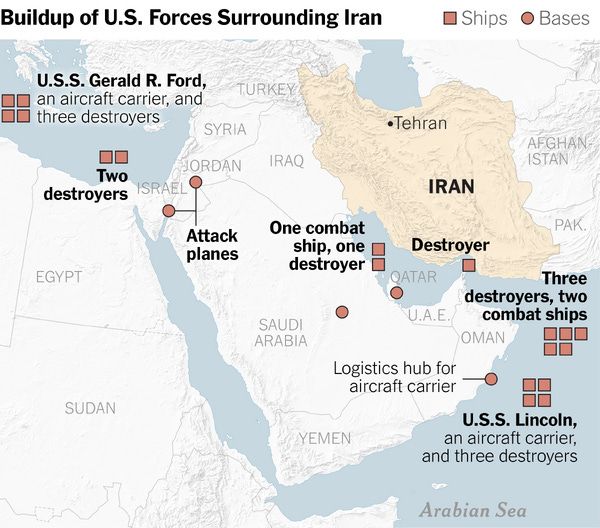
Graphic: New York Times
In late February, U.S. and Iranian negotiators met for a third round of talks in Geneva, Switzerland. The U.S. demanded the total dismantling of the Fordow, Natanz, and Isfahan nuclear sites and the shipping of all enriched uranium to the U.S., which Iran flatly rejected.
Despite a last-minute claim by Oman of a “breakthrough,” the U.S. determined that Iran was merely stalling for time. Satellite imagery showed U.S. ships leaving Bahrain (a standard defensive move before an attack).
The U.S. and Israel Strike Iran
At around 1:15 am ET on February 28th, the Israeli’s launched “Operation Roaring Lion” alongside the U.S. operation entitled “Operation Epic Fury.” Operation Epic Fury sought to dismantle Iran’s security apparatus, targeting “Islamic Revolutionary Guard Corps (IRGC) command and control facilities, Iranian air defense capabilities, missile and drone launch sites, and military airfields,” according to a press release put out by the US. CENTCOM. The U.S. strikes destroyed key sites of the Iranian Navy, ballistic missile factories, and long-range air defense systems to secure regional air and sea supremacy.
While the Pentagon targeted major Iranian military installations and infrastructure, Israeli forces focused on decapitating Iran’s political leadership. In the initial wave of strikes, US-Israeli forces confirmed the deaths of:
Ayatollah Ali Khamenei, Iran’s Supreme Leader
General Abdol Rahim Mousavi, Iran’s Army Chief of Staff
General Aziz Nasirzadeh, Iran’s Defense Minister
Major General Mohammad Pakpour, Commander of the IRGC
Ali Shamkhani, Secretary of the Iranian Security Council
There have also been civilian casualties. Most notably, Israeli strikes killed at least 180 people, many of whom were children, in a strike on an elementary school in the southern Iranian city of Minab.
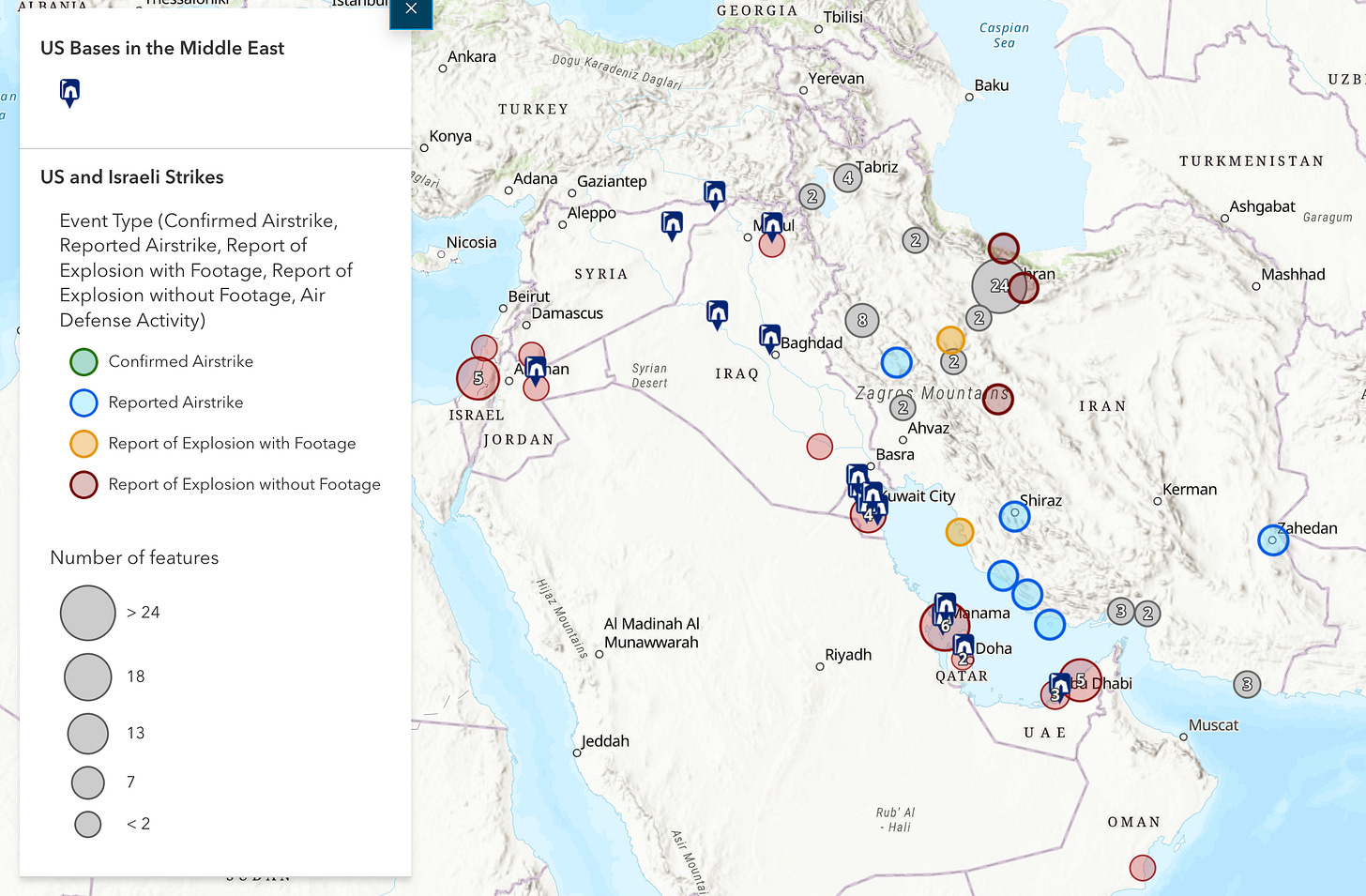
Graphic: Institute for the Study of War
Is the U.S. at war with Iran?
Technically, no. President Trump declared these strikes as “major combat operations,” not as a declaration of war. Strictly speaking, only Congress has the authority to declare war via simple majority vote in both the House and Senate (U.S. Const. art. I, § 8). However, what is clear is that the U.S. is in a state of armed conflict, as a matter of domestic and international law. Presidents have often cited their authority under Article II, “Commander-in-Chief” powers to launch preemptive or defensive operations without Congressional approval. Under the War Powers Resolution, the President must “consult with Congress before introducing United States Armed Forces into hostilities” (Trump notified the Congressional “Gang of 8” before the strikes) and cannot last for more than 60 days without a formal declaration of war. According to international law, the U.S. and Israel are both in a state of armed conflict with Iran and vice versa, even though the U.S. isn’t “at war” with Iran.
How is Iran responding?
Shortly after the first wave of strikes by the U.S. and Israel, Iranian forces swiftly retaliated by striking previously evacuated U.S. bases throughout the Middle East, including facilities in Bahrain, Qatar, the United Arab Emirates, Kuwait, Jordan, and Saudi Arabia. Among Gulf allies, Iran struck hotels, residential areas, and airports in Dubai (UAE), Kuwait, Iraq, Bahrain, Qatar, and Tel Aviv. As of 9:30 am ET today, U.S. CENTCOM has confirmed the death of three U.S. servicemembers and the serious injury of five other servicemembers as part of Operation Epic Fury.
Iran’s top leaders are dead. What happens now?
For the Iranian regime, the most immediate concern is succession. With the decapitation of its top political and military leaders, the regime lacks the same centralized power center that it had even one month ago, when it violently quelled protests in January. On March 1, Iranian state television announced an interim leadership council, including Iranian President Masoud Pezeshkian, Guardian Council jurist member Ayatollah Alireza Arafi, and Iranian judiciary head Gholam-Hossein Mohseni-Eje’i. But under Iranian law, the 88-member Assembly of Experts is ultimately responsible for choosing the next Supreme Leader.
There are a few contenders for the next leader of Iran. Iranian cleric and Ali Khamenei’s son, Mojtaba Khamenei, is a potential pick, though this pick may anger even supporters of the regime over gripes that the nepotism displayed was the same kind of favoritism that got the original Iranian shah ousted in 1979. Alireza Arafi, a Shiite cleric, is the deputy chairman of the Assembly of Experts and a member of the Guardian Council responsible for approving candidates, so his name would likely be rubber-stamped. Mohammad Mehdi Mirbagheri, a hard-line conservative, is another name that has come up, as well as Hassan Khomeini, the grandson of the original Ayatollah.
Then, there is the option that many in Washington and Israel are discussing: regime change.
Will decapitation lead to regime change?
In his first public address following Operation “Epic Fury,” President Trump made a bold call for the Iranian people to overthrow the clerical regime:
“Finally, to the great proud people of Iran, I say tonight that the hour of your freedom is at hand…When we are finished, take over your government. It will be yours to take. This will be probably your only chance for generations…Now is the time to seize control of your destiny, and to unleash the prosperous and glorious future that is close within your reach. This is the moment for action. Do not let it pass.”
~ President Donald Trump, February 28, 2026
Yet, despite Trump’s aid of “overwhelming strength and devastating force,” his proclamation to “take over [the] government” is much easier said than done. I don’t have all the details yet, but I can provide a window into what might determine whether regime change happens or not based on historical precedent. Long story short, something needs to change if the Iranian regime is to fall. Here’s why.
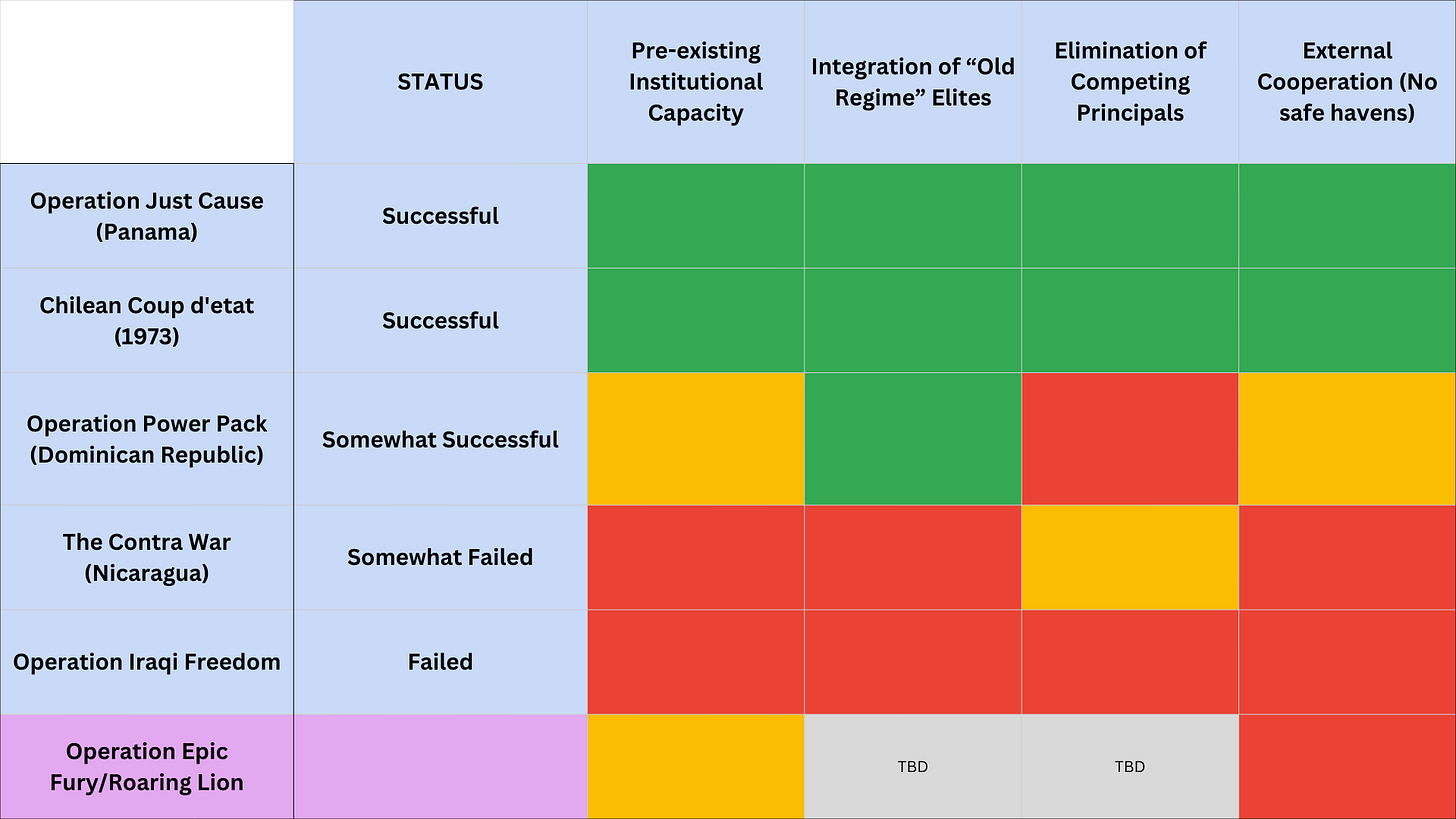
Graphic: Rules of Engagement. The chart shows different historical cases of foreign-imposed regime change attempts based on their relative levels of success. The columns display the four factors of successful regime changes, and the colored boxes represented whether that case meets the respective criteria (green = yes, yellow = somewhat, red = no).
Based on analysis of regime change aspects (RAND Corporation, Alexander Downes, Lindsey O’Rourke), four main factors dictate the success or failure of foreign-imposed regime change:
Pre-existing institutional capacity: Strong, centralized bureaucracies and a history of organized state institutions tend to ease political transition while maintaining continuity of essential state functions, as opposed to strict personalist regimes, where power and state capacity are concentrated within the leaders themselves.
Integration of “Old Regime” Elites: Success often requires co-opting parts of the existing military and civil service. When the intervening power completely dismantles the old regime’s security forces, it creates a power vacuum and a massive pool of armed, unemployed experts who often form the backbone of a new insurgency.
Elimination of Competing Principals: The “Competing Principles” dilemma arises from a newly installed leader who must appease two different forces. The leader must appease the foreign patron without appearing as a puppet, while also appeasing the domestic public without losing the approval of the intervening power.
External Cooperation (No safe havens): Foreign-imposed regime change is significantly more likely to succeed if neighboring countries do not provide “safe havens” or funding for insurgent groups. The presence of a non-aligned, third-party actor often extends the conflict indefinitely.
In the interest of time, I’ll only dive into two examples. The invasion and deposition of Manuel Noriega in Panama (Operation Just Cause) was largely successful because it already had a well-functioning public education system, constitutional frameworks, and administrative infrastructure established in the early-to-mid 20th century. Furthermore, instead of purging officers from the Panamanian Defense Forces, the U.S. instead “re-hatted” them into the newly-formed Panamanian Public Forces to avoid total collapse of public order. And on top of that, there was no issue of competing domestic interests, as Guillermo Endara (the U.S.-installed President of Panama) was popularly elected and enjoyed widespread support. Finally, while neighboring countries condemned the U.S. for its foreign intervention, they largely accepted Operation Just Cause as a fait accompli because they themselves had exhausted other means of getting rid of Noriega.
In contrast, Operation Iraqi Freedom largely failed because it lacked all four factors for success in foreign-imposed regime changes. Saddam Hussein’s bureaucracy was loyalty-based, which the U.S. entirely disbanded rather than “re-hat”. Iraq remained largely fractured from leaders who could not satisfy both patrons and the populace. And regional neighbors like Iran and Syria provided safe havens for foreign militias, leading to a protracted proxy war lasting decades.
How does this relate to Operation Epic Fury?
For Iranians to successfully overthrow their government, it will take more than a pep talk from Truth Social. From my assessment, much of Iran’s institutional capacity is concentrated within the IRGC. If the IRGC remains intact, it acts as a “competing state”; if it is destroyed, the administrative backbone of the country disappears, risking a power vacuum. It will also be challenging to “re-hat” existing Basij or Artesh members, as Iran’s forces are centered around a deeply ideological regime that has lost all popular support from the Iranian people.
In my mind, the most pressing issue is that there is no clear U.S.-backed successor like Guillermo Endara in the Panama case. The time to capitalize upon Operation Epic Fury is now, but there doesn’t seem to be much institutional momentum. This is partly because of fear of IRGC retaliation and partly because there lacks a cohesive movement or rally around someone that could take Khamenei’s place. With the transition council already in talks to replace top leadership, their window of opportunity will quickly close, especially as the IRGC forces regroup from the initial waves of attack. The Pentagon is highly unlikely to put boots on the ground, and the U.S. has never toppled a regime purely by air support.
The situation in Iran is quickly unfolding, and what this will mean for Iran, the Middle East, and the U.S. remains an open question. For President Trump’s part, he has shown an appetite to talk to the Iranians, though it is unclear to whom he is referring. If the goal of these talks is to leverage a deal with the current regime, it might be a good thing for immediate casualties but a blow to regime change activists.
Furthermore, there is the question of whether the Middle East is slipping into a wider regional war. I’m not sure, but there is no ideal outcome to this question. If hostilities stagnate, the intensity of the conflict may subside, but it would likely lead to a more protracted conflict. But if the regional conflict doesn’t stagnate, it could also drive more aggressive tactics from a severely weakened Iran that is desperate to get quick wins by all means necessary.
In the coming days, keep an eye out for how Gulf countries respond to kinetic attacks on their soil. Also, pay attention to what happens with Iranian-backed proxies, such as Hezbollah, Hamas, the Houthis, and Shi’a militia groups in Iraq and Syria. I don’t have all the answers, and this story is still developing, but I know that we could be living through a major inflection point in the “post-rules-based international order” era. Do not sleepwalk through this moment.


_(55121599389).jpg)