



BLUF
On March 1, two Iranian drones operated by the Iranian Revolutionary Guard Corps flew into and struck Amazon Web Services data centers in the United Arab Emirates, and one more struck near a data center in Bahrain. According to the AWS health dashboard, the strikes caused structural damage and disrupted power delivery to a significant portion of the infrastructure at the affected sites. In some cases, AWS needed to suppress fires, which led to additional water damage. This is not an isolated instance. Throughout the war in the Gulf, the Russo-Ukrainian War, the Sudan Civil War, and the Myanmar Civil War, these types of attritable (low-cost and expendable), flying weapons are becoming the tool of choice for militaries and militia groups that want both extended surveillance times and cost-effective weapons systems.
Loitering munitions, also known as suicide drones or kamikaze drones, are autonomous or semi-autonomous aerial vehicles designed to hover around an area, collect surveillance data, identify a target, and engage it with their onboard warhead by flying into it. This article examines three such loitering munitions currently deployed in combat zones. The first is the small and common first-person viewer drone. The second is the Switchblade 600, a mid-sized tactical munition. And the third is the Shahed-136, a strategic “one-way attack” munition. While not exhaustive of loitering munitions, these weapons systems are redefining what modern warfighting means in the contexts of attritability, autonomous warfare, and artificial intelligence.
FPV “kamikaze” drones
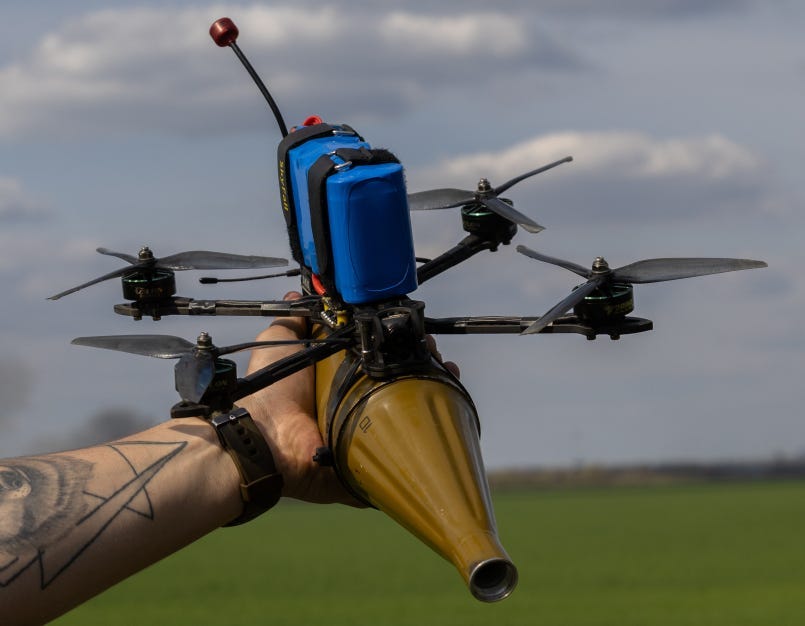
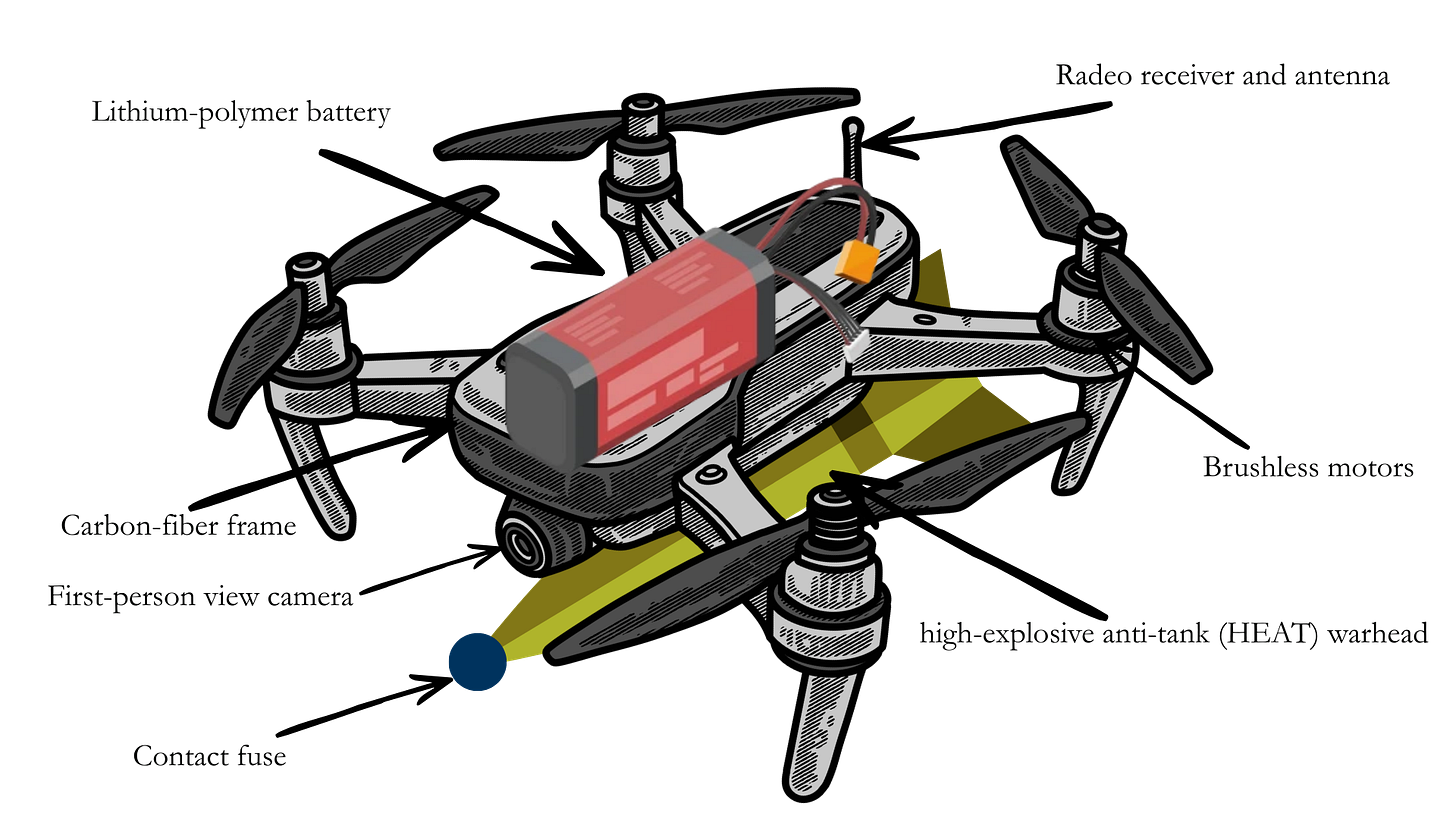
The common FPV drone features a carbon fiber or high-density polyethylene (HDPE) frame, both lightweight and strong. For example, a typical 5-inch frame is 4mm thick, weighs 210 grams, and is three times stiffer than steel and aluminum for its weight. FPV drones excel at precision strikes on armored vehicles, personnel, and infrastructure, typically using explosive payloads like high-explosive anti-tank (HEAT) warheads. On impact, a contact fuze detonates the explosive. FPV drones also serve in reconnaissance, artillery spotting, and aerial interception, making them versatile across military operations.
Despite their effectiveness, FPV drones face challenges such as vulnerability to electronic warfare and the need for skilled operators. Electronic warfare involves attempts to disrupt or disable communications or navigation using electromagnetic signals. Homemade and commercial FPV UAVs, such as drones from DJI, operate on 2.4 GHz and 5.8 GHz frequency bands. Jamming works by emitting an electromagnetic frequency that drowns out the communication between the drone and its operator. This has previously proven to be a major downside of FPV kamikaze drones. Russians and Ukrainians have each developed workarounds to this vulnerability. First, they use ultra-thin fiber optic cables to physically connect the drone directly to the operator, spooling out miles of wire as the drone flies. Fiber optic cables transmit data using light signals, which are not affected by radio interference. Because the control commands and the high-definition video feed travel through this physical tether rather than through the open air via radio waves, these fiber-optic drones are completely immune to electronic warfare and signal jamming.
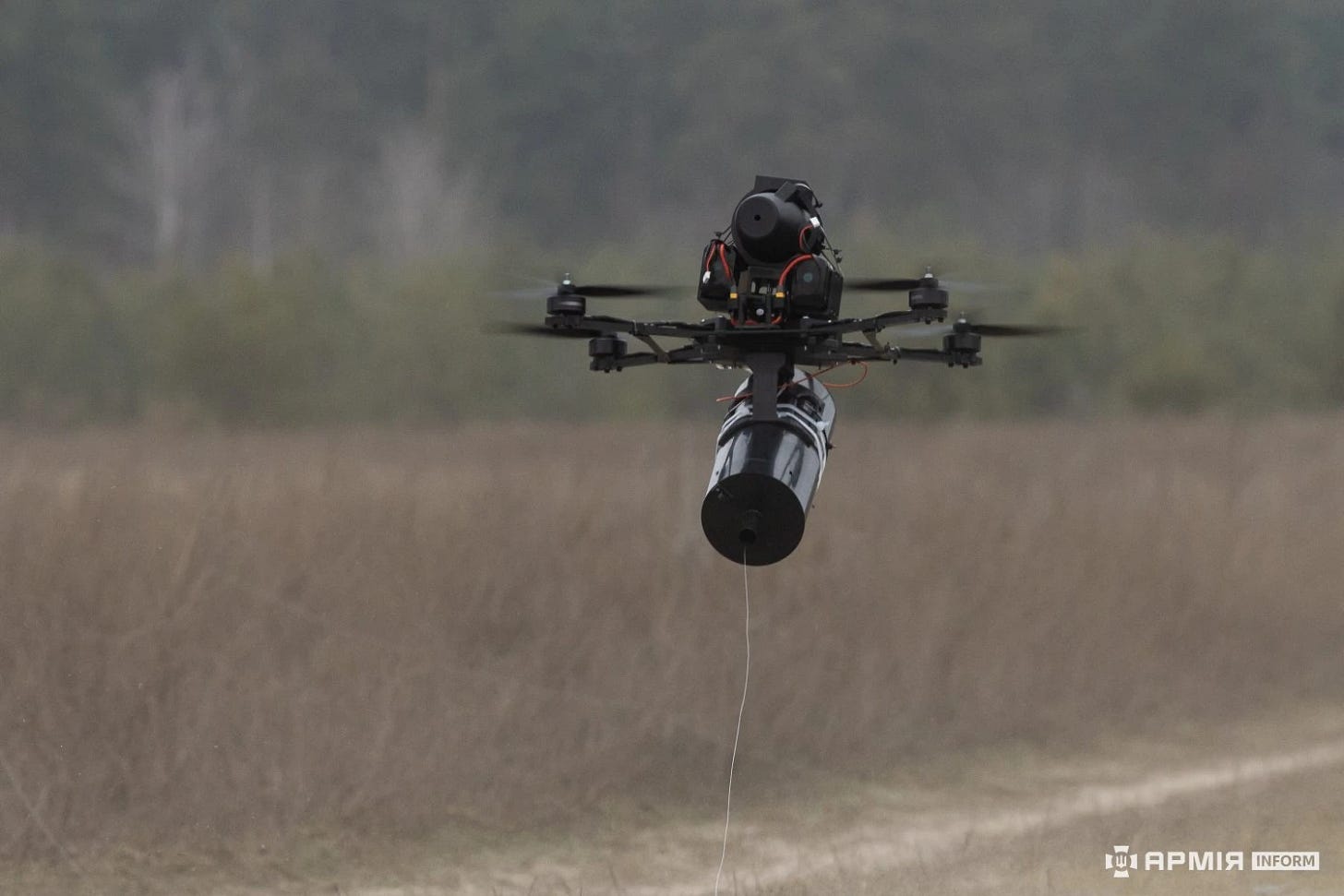
Graphic: https://commons.wikimedia.org/wiki/File:UA_fiber-optic_FPV_drone_02.webp
Second, the “Magic Radio” technology developed by Russian company Mikran uses frequency-hopping spread spectrum (FHSS) to protect drones from jamming in Ukraine. This system rapidly switches between frequencies up to 1,000 times per second, far faster than typical FHSS systems. It operates across a wide bandwidth of 100-6000 MHz, allowing for millions of possible frequency combinations. This adaptability allows the system to avoid congested frequency bands, further aiding in synchronization. The technology has reportedly enabled Russian Orlan-10 reconnaissance drones to operate successfully despite Ukrainian jamming efforts, with a range extending to around 150 km.
Finally, Ukrainian and American forces are incorporating autonomous terminal guidance systems into their drones to take over piloting functions even if the operator loses signal connection with the drone. In Operation Spiderweb last summer, Ukrainian forces struck five military airfields deep inside Russian territory. They targeted strategic bomber fleets stationed far behind the front lines. These Ukrainian systems were equipped with AI-driven machine vision and terminal guidance. When the signal was cut or jammed during the final approach, the onboard software took over, visually locking onto the fuel tanks and wing roots of parked Tu-95 and Tu-22M3 bombers to autonomously complete the attack dive with devastating precision.
FPV drones are quickly becoming a go-to option in modern warfare due to their cost-effectiveness and advancements in autonomous flight operations. For instance, the U.S. Army just announced a $5.2 million contract with Perennial Autonomy for its Bumblebee v2, a drone that can autonomously hunt down and intercept hostile drones by physically ramming into them midair. Powered by onboard artificial intelligence, the Bumblebee acts as an independent hunter-killer agent; it uses computer vision and specialized software to identify, track, and lock onto incoming enemy unmanned aerial vehicles. Once a target is acquired, the drone’s AI takes over the flight controls to execute a kinetic “hard kill”—colliding directly with the threat to knock it out of the sky. This autonomous guidance allows the drone to neutralize aerial threats effectively, even if electronic warfare jams the human operator’s control signal, all while avoiding the explosive collateral damage of traditional anti-aircraft missiles.
Tactical loitering munitions ~ The Switchblade 600
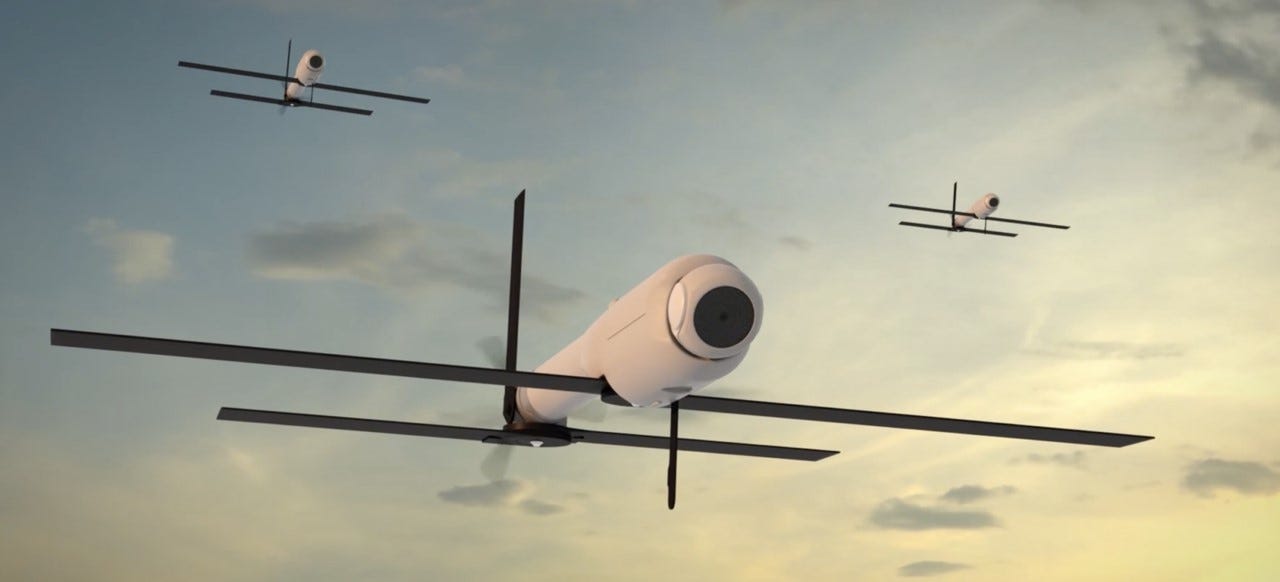
Tactical loitering munitions are mid-sized drones that can be designed to be deployed directly by frontline combat units—often carried in a backpack or launched from a light vehicle. It is fired into the air to autonomously circle over a localized battlefield, use onboard optical and thermal sensors to hunt for targets, and strike them with an integrated warhead upon the operator’s command.
The U.S. has invested heavily in this technology since the early 2000s. AeroVironment, an autonomous robotics company, began developing the Switchblade loitering munition in 2006. The Switchblade made huge strides throughout the 2000s and 2010s. It soon had rapid deployment capabilities, being ready to fire within 30 seconds. It was able to locate a man-sized target at its combat range in less than 20 seconds while operating at an altitude of 500 feet. The system’s endurance was enhanced, allowing for a loitering time of up to 10 minutes if immediate attack conditions were not met. In its terminal phase, the Switchblade could achieve speeds between 85-105 mph (137169 km/h). In 2020, AeroVironment unveiled a larger, faster, and longer-range version of the previous Switchblade iterations. The Switchblade 600 has better range and endurance compared to the smaller Switchblade 300 model. It also boasts improved target engagement and anti-armor technology. Finally, the bulkier size gives the Switchblade 600 the ability to carry heavier payloads, which allows operators more flexibility when engaging a diverse array of hardened targets.
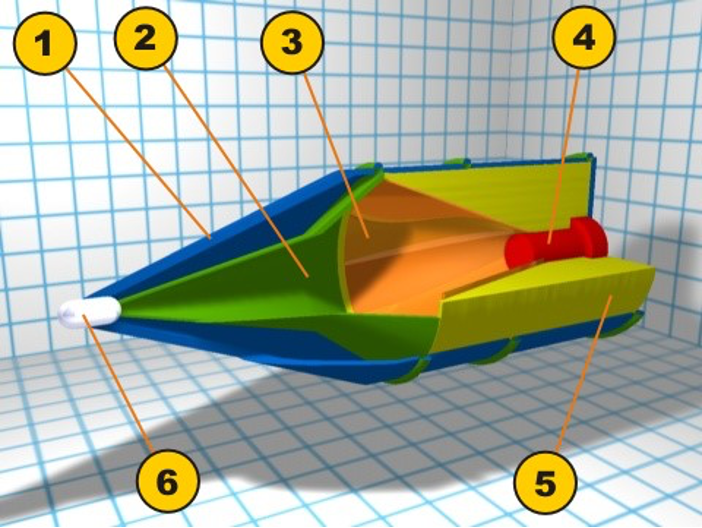
1: Aerodynamic cover; 2: Air-filled cavity; 3: Conical liner (Often copper); 4: Detonator; 5: Explosive; 6: Piezo-electric trigger.
The Switchblade 600 features a 40+ minute endurance time and a range of over 40 km (24.9+ miles), which can be extended to 90+ km (56+ miles) with the optional Pocket Digital Data Link (DDL), which enables sustained communication as the munition travels further from its operator. The system weighs 54.4 kg (120 lb.) in total, with the munition itself weighing 15.0 kg (33 lb.).
The Switchblade 600 is equipped with high-performance electro-optical/infrared (EO/IR) gimbaled sensors for improved target acquisition and an anti-armor warhead capable of defeating modern armor, including explosive reactive armor. It has a cruise speed of 112.7 km/h (70 mph) when in the surveillance stage of the mission and a dash speed of 185.1 km/h (115 mph) when actively engaging a target. The system can be set up and made operational in less than 10 minutes, offering a quick-response capability for various tactical situations.
The Switchblade 600 has a warhead similar to those housed in Anti-Tank Guided Missiles (ATGMs), the same warhead onboard the American-made Javelin FGM-148 (fire-guided missile). The difference between the two lies in the fact that the warhead is an undetachable part of the Switchblade 600, whereas an ATGM requires a delivery mechanism from which to launch or deploy. The payload is an 8.4 kg tandem-charge, HEAT warhead. A tandem-charge warhead consists of two separate explosive charges designed to defeat modern armored vehicles, especially those with reactive armor. The first charge (precursor) detonates to clear protective layers, while the second, larger charge (main) follows immediately to penetrate the vehicle’s main armor.
The Ukrainian military has actively used the Switchblade 600 on the front lines of the Russo-Ukrainian War, and the U.S. Army’s 1st Cavalry Division is conducting field tests with the Switchblade 600 as part of an effort to modernize its forces and upskill its operators. This platform is also equipped with autonomous features that are ushering in a new era of warfare. The Switchblade 600 is integrated with an automated target recognition (ATR) system within its edge compute (onboard the drone) that “autonomously detects and classifies both static and moving targets—including personnel, vehicles, aircraft, and maritime vessels.” The onboard ATR technology allows the drone to recognize a target and engage the target autonomously, with a human supervisor in the loop to abort the task or re-engage as necessary.
Strategic “one-way attack” drones ~ The Shahed-136
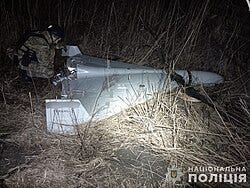
Now, back to that drone attack on the data centers in the UAE and Bahrain. The drone was a Shahed-136, a low-cost, Iranian-designed one-way attack drone released in 2021 that flies along a pre-programmed GPS route to a specific coordinate and detonates its explosive payload directly upon impact. The IRGC widely deploys the Shahed drone for its cost-effectiveness—each one costs between $20,000 and $50,000, compared to typical ballistic and cruise missiles, which can cost millions of dollars each.
Compared to the Switchblade and FPV kamikaze drones, the Shahed is much bigger. Its length is 3.5 m, and its wingspan is 2.5 m. It has a 50 horsepower, rear-mounted engine that pushes the fuselage at a maximum speed of 185 km/h. At a weight of 200kg (~440lbs), it is built more for maximum fuel efficiency rather than speed or evasive maneuvers. It has an estimated range from 1,000 to 2,500 km. It can fly at an altitude from 60 to 4,000 m. This also means that the Shahed physically cannot take off on its own power from a short launch rail and must thus use a rocket-assisted take-off (RATO) launch system.
Onboard, the Shahed-136 carries a high-explosive fragmentation warhead of around 30–50 kg, situated in the nosecone of the fuselage. This makes it optimal for striking counter-value targets like the AWS data centers in Bahrain and the UAE, Ukraine’s power grids and thermal heating plants, and the U.S. embassy in Saudi Arabia.
These fairly cheap, increasingly sophisticated attritable weapons will change the nature of how wars are fought, especially as agentic capabilities are developed, which allow for coordinated drone swarms, autonomous target engagement, and higher-level strategic reasoning embedded in edge computing. The question is less so when these technologies will be feasible, but when they will be safely incorporated into the kill chain without human approval chokepoints.
Even in their most basic forms, kamikaze drones are still popular because cheap is good and more is better. Loitering munitions are proving to be an effective tool without a particularly high technical barrier of entry—practically anyone can purchase these drones. Yet, this weapons system still has its limits. They cannot be deployed recklessly or without clear intent, and they certainly shouldn’t be deployed under the assumption that any loitering munition will be apt for a strategic objective in any geopolitical theater. Kamikaze drones will not and cannot replace thoughtful analysis, skillful weaponeering, and calculated restraint.


