



Graphic: https://cdn.slowdownwiseup.co.uk/media/original_images/70194.jpeg; https://www.gettyimages.com/eula?utm_medium=organic&utm_source=google&utm_campaign=iptcurl
BLUF
The U.S. has recently ramped up airstrikes against vessels off the coast of Venezuela. With the arrival of the largest U.S. (and global) aircraft carrier in the Caribbean Sea, there is concern of escalation and even physical altercation between the U.S. and Venezuela. President Trump has broad authority to recognize the Venezuelan government as illegitimate, designate drug cartels as foreign terrorists, and carry out targeted sanctions. However, an insufficient connection between them and the Maduro regime suggests that the actions of the cartels cannot be attributed to the actions of the Venezuelan government. And claims that drug trafficking constitutes an “armed attack” are dubious and likely do not justify U.S. airstrikes on the Venezuelan vessels.
How did we get here?
How legal is it?
Non-recognition of Maduro’s regime
The ability of President Trump to reject the legitimacy of Maduro’s regime is deeply justified in historical and court precedent. The authority of the President to recognize foreign governments is rooted in the “Reception Clause” of Article II in the Constitution. While the Constitution does not explicitly enumerate this authority, it has, nonetheless, been reaffirmed by the Supreme Court as an exclusive power of the President—Zivotofsky v. Kerry (2015) for all you con law nerds out there. On the international law front, de jure recognition of a foreign government is a political discretion and not a legal obligation, so there is pretty wide latitude there as well.
Designation of Narco-terrorist status (and holding Venezuela responsible)
In early 2025, the administration designated groups such as the Tren de Aragua (TdA) and Cartel de Los Soles (CdLS) as foreign terrorist organizations and narco-terrorist groups. Broadly, this action is justified through two statutes. The Foreign Terrorist Organizations designation clause under the Immigration and Nationality Act (INA) authorizes the Secretary of State to designate foreign organizations as terrorist groups. Meanwhile, the administration used the International Emergency Economic Powers Act (IEEPA) to declare a national emergency and thus impose sanctions on these groups. However, critics of this designation argue that designating a group as a “terrorist entity” requires more than criminal activity, including political motivation.
Okay, so what about claims by the White House that these organizations are tied to the Venezuelan government? Under international law, a state can be held responsible for the action of a non-state entity in two ways. First, the ICJ established in United States v. Nicaragua (1984) that a state must have “effective control” over a non-state group, which involves the specific direction (not simply supply or tolerance) of the actions by the non-state entity, to warrant attribution. A lower standard established by the International Criminal Tribunal for the former Yugoslavia (ICTY) requires that a state have “overall control” of a non-state group, which only requires coordination or significant funding to warrant attribution. Intelligence assessments suggest that there is no evidence that Maduro’s regime meets either of these standards.
U.S. intervention in Venezuela: sanctioning, CIA-ing, and sinking
Notwithstanding whether the actions of TdA and CdLS can be attributed to the Venezuelan government, let’s talk about the justifications and
criticisms of U.S. actions towards and around Venezuela.
Economic sanctions and CIA operations
Under domestic law: The Trump administration launched broad economic sanctions under statutes like IEEPA and the National Emergencies Act. Critics argue that these broad authorities are not absolute and come with major separation of powers concerns, as they encroach on Congress’s powers to regulate foreign commerce and provide oversight. However, whatever the merits of these critiques are, it goes without saying that multiple administrations from Carter to Obama have invoked this broad executive authority. As far as clandestine CIA operations go, the President can claim broad authority under the National Security Act of 1947 to approve covert actions.
Under international law: Typically, intervention in the external affairs of a foreign state is impermissible without approval from the UN Security Council under Chapter VII authority. However, there are a few exceptions. Let’s explore:
* Self-defense under Article 51 of the UN Charter after or in imminent danger of an armed attack. The bar for an armed attack in international law is quite high; the U.S. likely does not have a case here.
* Consent of the target state. This is clearly not the case—the U.S. certainly does not have Maduro’s consent, and even if Trump received consent from Edmundo Gonzalez (which the U.S. recognizes as the legitimate president), he does not have authority under international law to request support, as he is not the de facto leader of Venezuela.
* Humanitarian intervention: This is not a widely accepted exception, but it has nonetheless been invoked as a justification for intervention many times before. As far as economic sanctions on Venezuela go, Trump might have a case here. There is widespread evidence of human rights abuses from the Maduro regime. Targeted economic sanctions against Venezuela could be justified here. Notice how I said “economic sanctions” here and not airstrikes? We’ll get to that in a bit.
Regarding CIA actions, there is a similar issue of violating the principle of sovereign equality and non-intervention in a state’s internal affairs under Article II of the UN Charter. Yet, covert actions have been used in multiple Presidential administrations as well.
Airstrikes on Venezuelan vessels
The justifications for these strikes: The Trump administration argues that the flow of drugs to the U.S. shores constitutes a direct national security threat against the American people; thus, these strikes are warranted as a defensive measure. What about the fact that these extrajudicial killings occurred in Venezuelan territory? Well, there is a justification about jurisdiction known as the “unwilling or unable” doctrine. Under this disputed area of customary international law, the Trump administration could justify carrying out operations outside its jurisdiction because Maduro created a friendly environment for these drug syndicates, thereby showing an unwillingness to address threats that originate on Venezuelan soil. Finally, the “Commander-in-Chief” clause in Article II of the Constitution gives the President latitude to direct military operations in domains that Congress has approved, such as counternarcotics and counterterrorism.
So, what’s the issue?
Why these strikes may be illegal: The validity of the “self-defense” claim by the Trump administration relies on a threshold known as “the gap,” or the difference in severity, scale, and consequences that separates an armed attack from less serious kinetic interventions. The U.S. can only strike these vessels in self-defense if Venezuela has met the bar for an armed attack in the gravity and effects of cocaine and marijuana coming to the U.S. I’ll leave this judgment up to you, but my intuition is that it doesn’t.
The Trump administration has also claimed that the U.S. is in a state of armed conflict with these “narco-terrorists.” Okay, let’s assume for a sec that we are in a justifiable state of armed conflict with TdA and CdLS. The Trump administration still runs afoul of jus in bello principles, or the laws of armed conflict. First, these boat strikes would need to adhere to the principle of distinction, discriminating between combatant and noncombatant people aboard these vessels. The administration has not provided evidence that this determination was made. Okay, what about collateral damage? Civilians are killed all the time in armed conflict. Yes, this is true, but states must account for proportionality, which aims to balance military force with military advantage. In this case, you have lethal force, used against mostly small boats, all with a disputed threat level, and without clear regard for noncombatant immunity. Furthermore, if U.S. forces were able to track these vessels through ISR and could theoretically intercept the vessels by other means, it is not entirely clear that these strikes were militarily necessary.
Invasion of Venezuela?
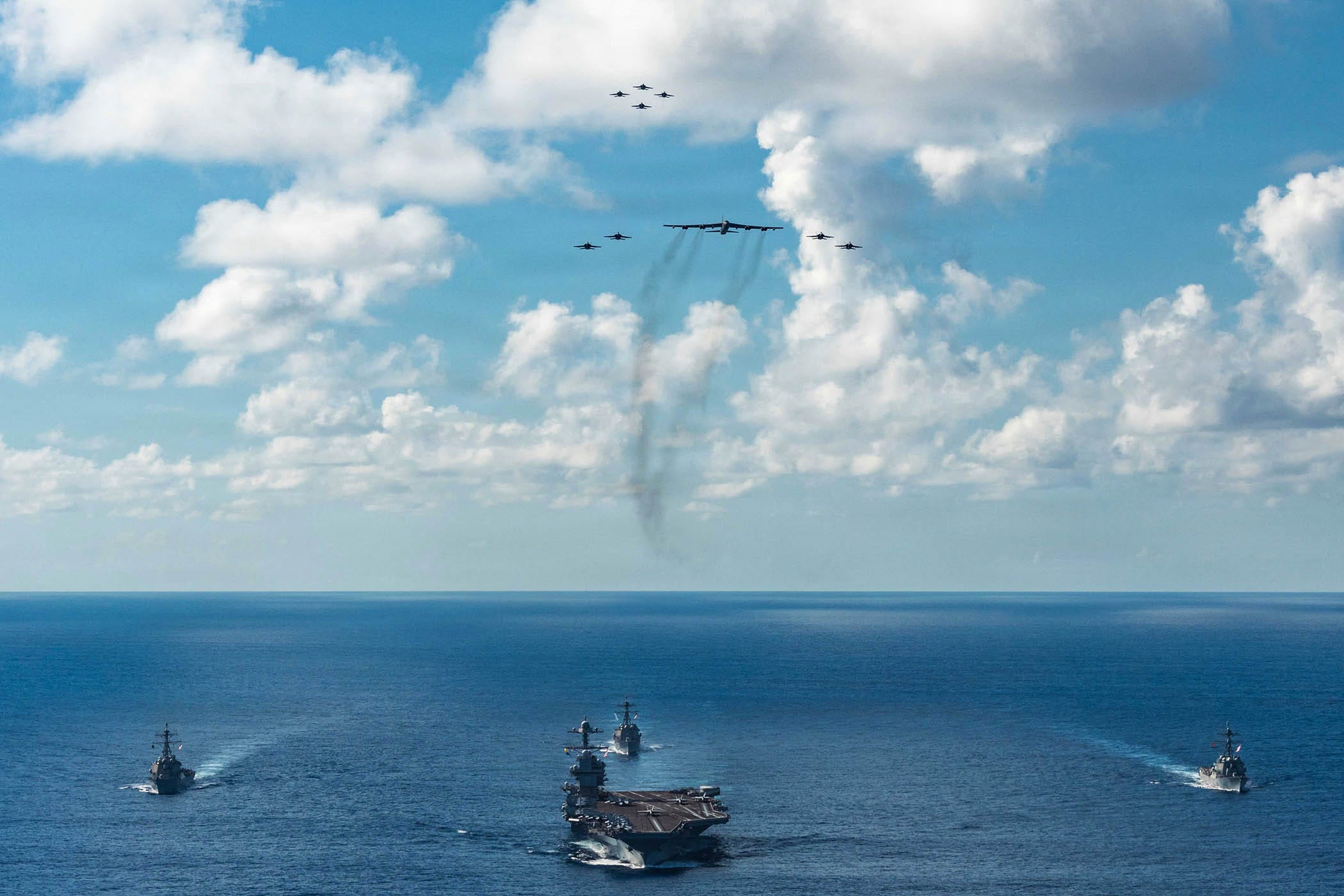
Today, the U.S.S. Gerald R. Ford reached the Caribbean Sea. What does this mean for the future? Well, if I knew how the future would unfold for everything in the world, my Substack would be a lot more popular, and I’d be a much wealthier man. But Trump has noted that, in addition to airstrikes, the U.S. would commit to “stop the drugs coming in by land.” And with the massive mobilization of troops by Maduro to defend against U.S. incursions, this escalatory environment is concerning to say the least. Like all history, hindsight is 20-20, and for now, we’ll just have to wait and see.
*Update: As of around 10pm last night, President Trump said that the U.S. may be open to discussions with Maduro.
Thank you for subscribing. Share this episode.


